
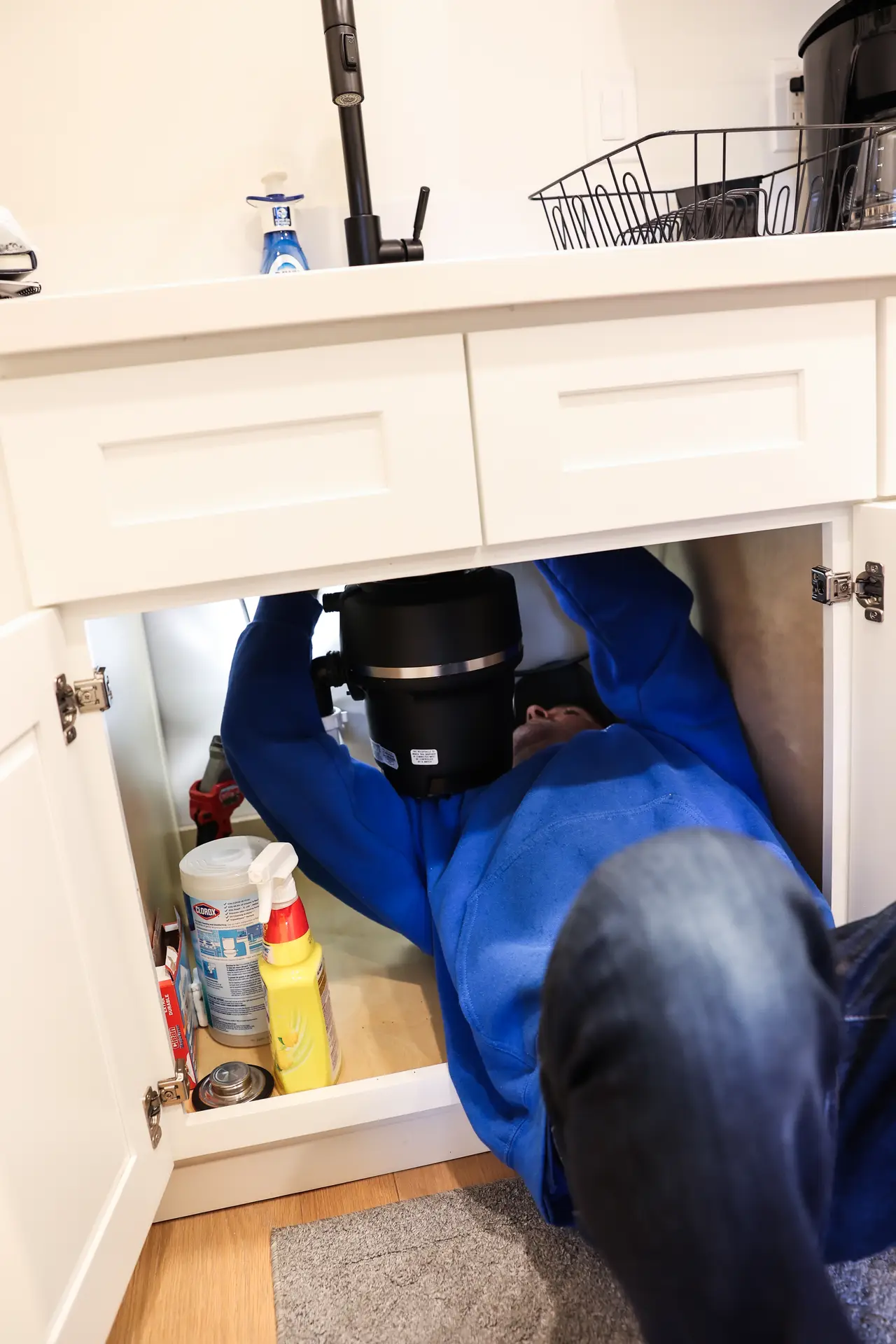
There's no single number that answers "what does a new garbage disposal cost," and anyone who gives you one without asking a single question about your kitchen is guessing. The honest answer depends on the unit itself, what's already under your sink, and whether the job stays a simple swap or turns into something more involved.
That said, there are real, predictable patterns. Most installations fall into a fairly tight range once you know what's driving the price, and understanding those factors ahead of time means you won't be caught off guard by a quote, whether it comes in lower or higher than you expected.
This guide breaks down what actually goes into a garbage disposal installation, what typically drives the cost up or down, and what a straightforward install versus a more complicated one looks like. Whether you're in Nipomo or elsewhere in the county, by the end you'll have a realistic sense of where your project is likely to land before a plumber ever sets foot in your kitchen.
In this article, you will learn about:
- What typically makes up the total installation cost
- The factors that push price up or down
- What a straightforward installation looks like versus a complex one
- How to get an accurate quote for your specific kitchen
Keep reading to get a clearer picture of your project's actual cost, not just a national average that may not apply to your home.
What typically makes up the total installation cost
A garbage disposal installation bill isn't one number, it's a handful of separate costs that combine into a total. Breaking those pieces apart makes it a lot easier to understand where your money is actually going, and where there's room to save.
Most quotes bundle these together into a single line, which is convenient but can also make it hard to know what you're really paying for. Understanding the components individually gives you a much better sense of what a fair price looks like for your specific situation.
The unit itself is usually the smaller half of the total
The disposal unit accounts for a meaningful chunk of the total, but it's rarely the majority. Basic models with lower horsepower and simpler grinding mechanisms cost less upfront, while higher horsepower, quieter, or corrosion-resistant units cost more. For most residential kitchens, a mid-range unit strikes the right balance between price and performance.
It's tempting to shop entirely on unit price, but the cheapest disposal isn't always the best value once you factor in noise level, grind quality, and how long it's likely to last before you're back to comparing disposal repair against a second replacement.
Labor makes up the largest share of a typical job
Labor is usually the bigger piece of the bill, and it covers more than just physically mounting the new unit. A plumber removing an old disposal, inspecting the mounting assembly and drain connections, and confirming everything is properly sealed and wired takes real time, even on a straightforward swap.
- Disconnecting and removing the old unit, including any corroded or stuck mounting hardware.
- Inspecting the sink flange, dishwasher connection, and drain trap for wear before installing anything new.
- Mounting, wiring, and testing the new unit under running water before calling the job done.
Straightforward swaps where the new unit matches the old one's mounting style and electrical setup tend to move quickly. Jobs where something under the sink needs correcting first take longer, and the labor cost reflects that additional time.
A few smaller line items round out the total
Beyond the unit and labor, a handful of smaller costs sometimes apply depending on your kitchen's setup. These aren't part of every job, but they're common enough to be worth knowing about before you get a quote.
- 1A new sink flange or mounting hardware if the original is damaged or incompatible with the new unit.
- 2Minor electrical work if the existing outlet or switch wiring needs updating to safely handle the new disposal.
- 3A dishwasher connection kit if your current disposal doesn't have one and your dishwasher drains through it, sometimes bundled with a broader water line check if the connection point shows any wear.
The factors that push price up or down
Two kitchens with what looks like the same job on paper can end up with fairly different quotes, and it usually comes down to a few specific variables. Knowing what those are helps you understand your own estimate rather than just comparing numbers blindly.
None of these factors are unusual or rare. They show up in ordinary kitchens across San Luis Obispo County all the time, and a good plumber will walk you through which ones apply to your situation before finalizing a price.
Horsepower and features change the unit price meaningfully
A basic 1/3 to 1/2 horsepower unit handles typical household scraps just fine for most homes. Larger households, or kitchens that see heavier use, often benefit from a 3/4 to 1 horsepower model, which grinds more thoroughly and jams less often but costs more upfront.
Beyond raw power, features like insulated grinding chambers for quieter operation, stainless steel components for corrosion resistance, and auto-reverse mechanisms that clear jams automatically all add to the unit's price. None of these are strictly necessary, but they're worth weighing against how much you actually use the disposal, especially in a household where inconsistent water pressure already affects how well the sink handles daily use.
Existing wiring and mounting compatibility matter more than most people expect
If your current setup already has a dedicated switch, proper wiring, and a compatible mounting flange, a straight swap is genuinely quick and affordable. Problems arise when the existing wiring is outdated, undersized for the new unit, or when the mounting hardware has corroded to the point of needing full replacement.
Older homes, particularly those with original plumbing dating back several decades, are more likely to need some amount of correction during installation. That doesn't mean every older kitchen faces a complicated job, but it's a real factor worth asking about upfront.
A first-time installation costs more than a straightforward swap
Replacing an existing disposal with a similar one is almost always cheaper than installing a disposal in a kitchen that's never had one. First-time installs sometimes require new electrical work, drain modifications, or a sink flange that wasn't previously in place, all of which add labor and materials that a simple swap doesn't need.
If you're converting from no disposal to having one, budgeting on the higher end of typical ranges is the safer assumption, especially in an older Central Coast home where the plumbing underneath may not have been designed with a disposal in mind.
What a straightforward installation looks like versus a complex one
It helps to picture both ends of the spectrum, since most real jobs fall somewhere between them. Knowing what separates a quick swap from a more involved project gives you a realistic sense of where your own kitchen is likely to land.
Neither scenario is unusual, and a good plumber can typically tell which one you're looking at within the first few minutes of inspecting under the sink.
A simple swap usually wraps up in one visit
When the new unit is a direct match for the old one's mounting style, the existing wiring is in good shape, and there's no dishwasher connection to reconfigure, the job is genuinely fast. A technician disconnects the old unit, confirms the mounting assembly is sound, installs and wires the new disposal, and tests it under running water, all within a single appointment.
- The sink flange and mounting ring are reused or swapped for a compatible match.
- The existing electrical connection powers the new unit without modification.
- The whole job, start to finish, typically takes under two hours.
This is the scenario most homeowners end up in, particularly when replacing a disposal that's simply reached the end of its service life rather than one that failed catastrophically or was never properly installed to begin with.
A more involved job adds time and materials, not complexity in the work itself
The harder jobs aren't technically difficult, they just require more steps before the actual installation can happen. Corroded mounting hardware needs to be carefully removed rather than simply unscrewed, sometimes revealing the kind of slow leak that leak detection work catches before it becomes a bigger problem. Undersized wiring needs upgrading to safely handle the new unit's draw. A missing dishwasher connection kit needs to be sourced and installed.
None of this is unusual, and a plumbing repair technician handles these situations routinely, but it does mean more labor hours and, often, additional parts beyond the disposal itself.
First-time installs in homes without existing infrastructure take the longest
Kitchens that have never had a disposal, common in some older homes around Santa Maria and elsewhere on the Central Coast, represent the most involved end of the spectrum. These jobs may require running new electrical, modifying the drain configuration alongside routine drain cleaning work, and adding a switch where none existed before.
This is also where the biggest cost variability shows up, since the scope depends entirely on what the existing plumbing and electrical setup can support versus what needs to be added from scratch.
How to get an accurate quote for your specific kitchen
National averages and online calculators are a reasonable starting point, but they can't account for what's actually happening under your sink. Getting a number you can actually rely on means having someone look at your specific setup.
A little preparation before that visit goes a long way toward getting a fast, accurate estimate rather than a rough guess that changes once the work starts.
A quick in-person look beats any online estimate
Photos and phone descriptions only go so far. A plumber who can physically inspect the mounting assembly, check the wiring, and confirm the drain configuration can give you a number that actually holds up, rather than a range that might shift significantly once the work begins.
This is especially true if your kitchen falls anywhere outside the simplest scenario, an older home, a first-time install, or a unit that's leaked or corroded significantly before failing.
A few details ready ahead of time speed up the process
Having some basic information on hand before your appointment helps a technician give you a faster, more accurate quote, and sometimes even a same-visit installation if the parts on hand are a good match.
- The brand and horsepower of your current unit, if you know it, or a willingness to let the plumber identify it on-site.
- Whether your kitchen plumbing setup includes a dishwasher that connects through the disposal.
- Any recent issues, leaking, humming, unusual noise, that led you to consider replacement in the first place.
Garbage disposals also carry a real, ongoing water cost worth factoring into the bigger picture, not just the installation bill. The U.S. Environmental Protection Agency has noted that a conventional disposal can run a water flow of 2.0 to 15.0 gallons per minute while in use, a modest but real ongoing factor alongside the upfront installation cost that's worth keeping in mind when weighing a higher-efficiency unit against a basic one.
An honest quote should explain the number, not just state it
A plumber who walks you through why a job costs what it costs, this part is a straight swap, this part needs new wiring, this part is the unit itself, is giving you something more useful than a flat figure. It lets you see where the money is going and where, if anywhere, there's room to adjust based on your priorities.
- Ask whether the quote includes removal and disposal of the old unit, or if that's billed separately.
- Confirm whether the estimate assumes a straight swap or already accounts for potential wiring or mounting issues.
- Clarify what happens to the price if the technician finds something unexpected once the old unit comes out.
That kind of transparency is worth more than chasing the lowest number on a page, since the lowest quote sometimes leaves out a step that shows up as a surprise later.
Conclusion
Garbage disposal installation cost comes down to a handful of predictable factors: the unit itself, the labor involved, and whether your kitchen needs any correction before the new disposal goes in. A straightforward swap in a kitchen with good existing wiring and mounting hardware is genuinely affordable and quick. A first-time install or a job with corroded, outdated infrastructure underneath takes more time and costs more accordingly.
The best way to know where your own project falls is a direct look at your kitchen rather than a national average that assumes a setup you may not actually have. That's the difference between a quote you can trust and a number that changes once someone's actually under the sink.
If you're ready to get a real number for your kitchen, the team at Drain Doctors Plumbing can take a look and walk you through exactly what your installation would involve.