
Your water heater is fighting a battle you can't see. Every gallon that passes through it carries dissolved minerals, and over months and years those minerals turn into a hard, insulating layer that makes your system work harder for the same amount of hot water.
San Luis Obispo County sits on some of the harder water in California, and that has real consequences for how long a water heater lasts and how much it costs to run one. This isn't a rare problem limited to a few unlucky homes. It's the water coming out of the tap in most of the county, tank after tank, year after year.
Understanding what hard water actually does inside your water heater, and what you can do about it, is the difference between a system that lasts well past a decade and one that needs replacing years early. The good news is that most of the damage is preventable once you know what to look for.
In this article, you will learn about:
- What hard water actually is and why the Central Coast has it
- How mineral scale builds up inside a water heater
- The warning signs that scale is already shortening your system's life
- What you can do to protect your water heater and extend its lifespan
Keep reading to find out whether your water heater is already showing the signs of hard water damage, and what to do before a full replacement becomes the only option.
What hard water actually is and why the Central Coast has it
Hard water isn't dirty water or unsafe water. It's water carrying a higher-than-average concentration of dissolved calcium and magnesium, minerals picked up naturally as water moves through rock and soil before it ever reaches your tap.
The minerals behind the hardness
Calcium and magnesium dissolve into groundwater and surface water as it travels through limestone, chalk, and other mineral-rich formations. The more contact the water has with these materials, the more mineral content it carries by the time it reaches a treatment plant or a well.
None of this makes the water unsafe to drink. The calcium and magnesium in hard water aren't a health hazard, and many municipal water reports classify hardness as a secondary consideration rather than a primary safety concern.
The real cost shows up somewhere else entirely: inside the appliances that heat, store, and move that water through your home, starting with your water heater.
Why San Luis Obispo County runs hard
The City of San Luis Obispo's most recent water quality report puts hardness at an average of 259 parts per million, with individual readings ranging from 126 to 317 parts per million across the year. That range sits solidly in the hard to very hard category by standard water classification.
- 0 to 60 parts per million is generally classified as soft
- 61 to 120 parts per million is moderately hard
- 121 to 180 parts per million is hard
- Above 180 parts per million is classified as very hard
San Luis Obispo's water spends much of the year in that very hard range, and other Central Coast communities drawing from similar groundwater and reservoir sources tend to land somewhere in the same territory. This isn't a one-time reading either. It reflects the underlying geology of the region, which means the hardness is a permanent feature of the water supply, not a temporary condition.
How this compares to the rest of the state
California as a whole varies widely in water hardness, from relatively soft mountain snowmelt in some regions to some of the harder water in the country in others. The Central Coast, including San Luis Obispo County, consistently lands on the harder end of that range.
That matters because water heater manufacturers generally design and warranty their products around national averages, not around hard water regions specifically. A tank rated for a 10 to 12 year lifespan in typical conditions may not reach that mark here without some attention to the mineral load it's dealing with every single day.
How mineral scale builds up inside a water heater
The mechanism is simple, even if the consequences aren't always obvious until a problem shows up. Heat speeds up the process that turns dissolved minerals into solid scale.
Why heat accelerates the problem
Calcium and magnesium stay dissolved in cold water fairly well, but heating water pushes those minerals out of solution. As water is heated inside a tank, the dissolved calcium precipitates out and forms solid deposits, primarily calcium carbonate, on the surfaces where heat is applied.
This is why a water heater accumulates scale faster than almost any other appliance in the house. It isn't just holding hard water, it's actively heating it every day, which is the exact condition that triggers mineral precipitation.
The hotter the water and the more often it's heated, the faster the buildup. A water heater running at a higher-than-necessary temperature setting is working against itself, accelerating the very process shortening its life.
What happens inside a tank system
Inside a traditional tank, scale settles at the bottom first, since that's where the heat source sits and where circulation is weakest.
- 1Sediment and mineral deposits accumulate along the tank floor, gradually forming an insulating layer between the burner or lower heating element and the water above it.
- 2This layer forces the system to run longer and work harder to reach the same temperature, since heat now has to pass through scale before it reaches the water. The U.S. Geological Survey notes that this kind of scale specifically lowers the efficiency of electric water heaters, on top of raising the cost of heating the water in any system.
- 3Over time, the buildup can trap moisture against the tank's metal lining, contributing to corrosion and eventual leaks at the seams or bottom of the unit.
A tank that's never been flushed can accumulate years of this layered buildup, and the deeper it gets, the less efficient and less safe the system becomes.
What happens inside a tankless system
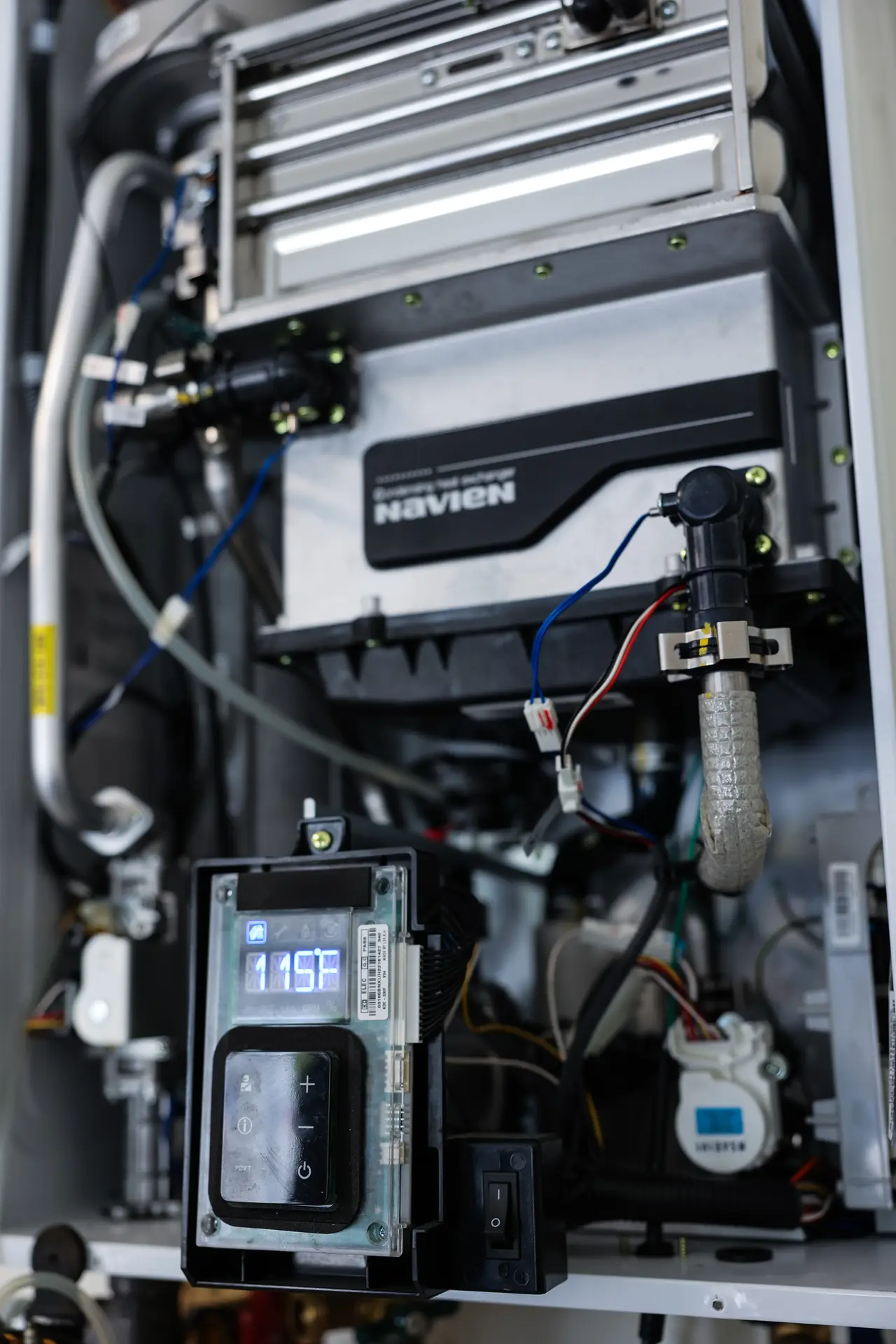
Tankless units don't store standing water, but that doesn't make them immune. Water still passes through a narrow heat exchanger every time hot water is called for, and that heat exchanger is exactly where scale wants to form.
- Mineral deposits narrow the internal passages of the heat exchanger, restricting flow and reducing the unit's ability to deliver its rated output.
- Scale buildup inside these tight passages happens faster than in a tank, simply because the surface area exposed to heat relative to the volume of water is much higher.
- Left unaddressed, this buildup can trigger error codes, reduce flow rate noticeably, and eventually cause the unit to shut down or fail outright.
Because the passages in a tankless heat exchanger are so much narrower than a tank's interior, hard water regions like the Central Coast tend to see scale problems show up faster in tankless systems than the manufacturer specs might suggest. If you're still weighing tank versus tankless for a new installation, hardness is one more factor worth putting on that list.
The warning signs that scale is already shortening your system's life
Scale buildup doesn't happen overnight, and most homeowners don't notice it until the symptoms are already affecting daily hot water use.
Sounds your water heater shouldn't be making
A water heater that's quiet when it's working properly and noisy once scale has built up is telling you something specific.
Popping, rumbling, or cracking sounds coming from a tank system usually mean water is trapped underneath a layer of sediment and turning to steam as it's heated, then bubbling up through the deposits above it. This is one of the clearest early indicators that scale has already accumulated to a meaningful degree.
A quiet, well-maintained system generally doesn't make these noises. If yours has started, it's worth having someone take a look before the buildup gets worse.
Performance changes worth paying attention to
Beyond noise, scale buildup shows up as a gradual decline in how well your system actually performs day to day.
- Longer wait times for hot water to arrive at the tap, especially noticeable in tankless systems where flow restriction slows delivery
- Inconsistent water temperature, cycling between too hot and lukewarm during a single shower or load of dishes
- A noticeable rise in your energy bill without any change in your household's hot water habits
Any one of these on its own could point to several different issues, but together they're a strong signal that mineral buildup is interfering with normal operation.
What happens if it goes unaddressed
Left unchecked, mineral scale doesn't plateau. It keeps accumulating as long as hard water keeps flowing through the system, which means the problems compound over time rather than staying constant.
A tank system that would normally last well over a decade can see that timeline cut down meaningfully when scale is allowed to build unchecked year after year. Tankless systems facing the same neglect can develop flow and error-code issues within just a few years of installation rather than the many years they're designed for.
What you can do to protect your water heater and extend its lifespan
None of this means hard water makes a long-lasting water heater impossible. It means the maintenance schedule that works in a soft water region isn't enough here.
Routine flushing and descaling
For tank systems, periodically draining and flushing the tank removes the loose sediment before it hardens into a stubborn, insulating layer. In a region with San Luis Obispo's hardness levels, this needs to happen more often than the once-every-few-years pace that might be fine somewhere with softer water.
For tankless systems, a periodic descaling flush, circulating a mild acidic solution through the heat exchanger, clears mineral deposits from those narrow internal passages before they restrict flow or trigger error codes.
- 1Tank systems in hard water areas generally benefit from more frequent flushing than manufacturer defaults assume.
- 2Tankless systems need a dedicated descaling service on a schedule matched to actual local water hardness, not a generic national recommendation.
- 3Either type benefits from a professional inspection that can catch early scale buildup before it becomes a noise, temperature, or efficiency problem you notice on your own.
Temperature settings that work with you, not against you
Since heat is what triggers mineral precipitation in the first place, an unnecessarily high temperature setting speeds up scale formation for no real benefit. Most households don't need water hotter than what's required for safe, comfortable use, and dialing back an overly aggressive setting can meaningfully slow the rate of buildup.
This is a small adjustment, but it works alongside flushing rather than replacing it. The two together do more than either one alone.
Water treatment as a longer-term fix
For homes dealing with the higher end of San Luis Obispo's hardness range, a whole-home water softening or conditioning system addresses the mineral load before it ever reaches the water heater, rather than managing the consequences after the fact.
EPA WaterSense notes that these systems work by exchanging the calcium and magnesium ions in hard water for sodium or potassium ions, and can help protect appliances in homes dealing with significant hardness. This is a bigger decision than a maintenance flush, and it's worth weighing against your specific water hardness, your household's usage, and the age and type of your existing system.
Whether flushing alone is enough or a treatment system makes more sense for your home depends on specifics that are hard to judge without seeing the actual water heater and the buildup already inside it.
Conclusion
Hard water is simply part of living on the Central Coast, and San Luis Obispo's own water quality data confirms it sits well into the hard to very hard range for much of the year. That reality doesn't have to mean a shortened water heater lifespan, but it does mean the standard maintenance schedule built for softer water regions isn't going to cut it here.
The noises, the slower hot water, the creeping energy bill, these are all signs worth taking seriously rather than living with until the system fails outright. Catching scale buildup early is almost always less expensive and less disruptive than dealing with a tank that's failed years ahead of schedule.
If your water heater has started making noise, taking longer to deliver hot water, or driving your energy bill up without explanation, Drain Doctors Plumbing can take a look, flush what's already built up, and help you figure out the right maintenance schedule for your home's actual water hardness. Reach out to Drain Doctors Plumbing to get started.