
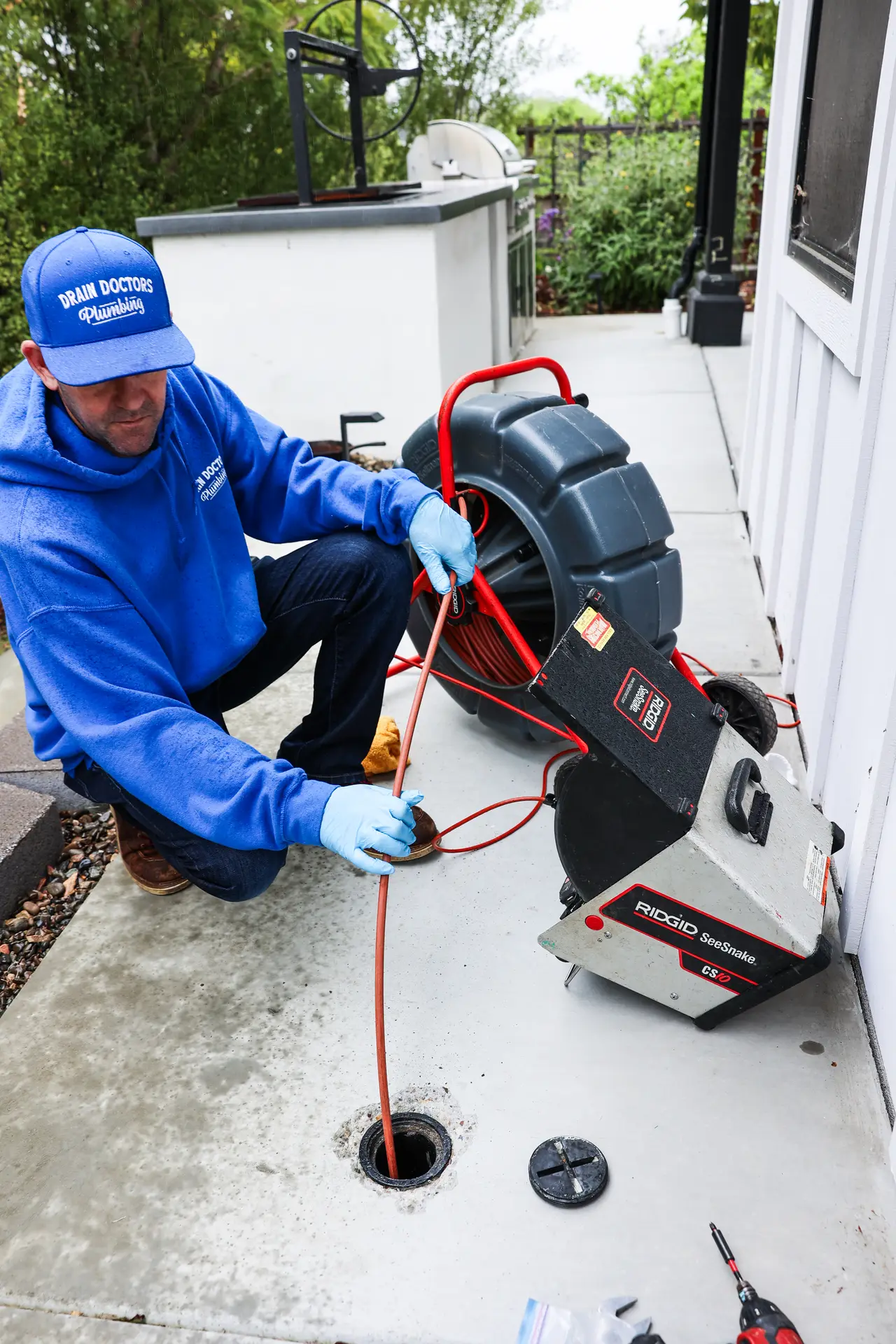
If your house predates the 1980s, there's a good chance the sewer lateral running from your foundation to the street has never actually been looked at. Most homeowners only think about a sewer camera inspection after something's already gone wrong, which is exactly backward for a pipe that's had decades to quietly deteriorate underground.
Older homes carry more risk here than newer construction, not because age alone causes failure, but because the materials and installation standards from decades ago simply don't hold up the same way modern PVC does. A property built in 1965 and one built in 2015 aren't playing by the same rules, and the inspection schedule that makes sense for one doesn't make sense for the other.
This article lays out a realistic baseline for how often an older Central Coast home should have its lateral inspected, what pushes that interval shorter, and how to fold the habit into normal home maintenance instead of treating it as an emergency response.
A sewer camera inspection is quick enough to schedule proactively, which is really the whole point of building a regular interval around it in the first place.
In this article, you will learn about:
- Why age changes the answer
- The baseline schedule for most older properties
- What moves you off the standard schedule
- Building inspections into normal home maintenance
Keep reading to find out where your own home likely falls on this timeline and what to do about it.
Why age changes the answer
There's no universal inspection interval that applies equally to every house, because the pipe underneath a 1960s home and the pipe underneath a 2020 build are made of different materials, installed to different standards, and have had wildly different amounts of time to develop problems.
Treating every property the same way, whether that means over-inspecting a newer home or, more commonly, under-inspecting an older one, misses the point of scheduling an inspection at all. The interval should track the actual risk sitting under the yard, not a generic number pulled from an unrelated property.
Homes in established neighborhoods across San Luis Obispo tend to skew older than newer subdivisions elsewhere in the county, which is part of why this question comes up so often locally.
The sections below cover what actually counts as "older" in this context, why the pipe material matters as much as the calendar year, and how a home's inspection history, or lack of one, factors into a reasonable starting point.
What counts as an "older" home on the Central Coast
For sewer lateral purposes, "older" generally means anything built before the 1980s, when PVC became the standard material for residential sewer lines across most of California. Homes from that era were typically built with clay or cast iron laterals instead, materials that behave very differently over multiple decades in the ground.
Inland communities like Atascadero have a meaningful share of housing stock from exactly this era, which is part of why the topic comes up as often as it does there.
A home from the 1990s or 2000s isn't automatically low-risk either, since PVC installed poorly or subjected to significant ground movement can still develop problems. But as a general rule, the older the home, the more likely the original lateral material is one that benefits from closer, more frequent attention.
Clay, cast iron, and why material sets the clock
A university deterioration study out of Hong Kong Polytechnic University modeled vitrified clay pipe's useful service life at about 39 percent shorter than concrete pipe in the same analysis, a gap that lines up closely with why so many original Central Coast clay laterals installed before the 1980s are now well past the point where periodic checkups start to matter.
Cast iron behaves differently but ends up in a similar place: it corrodes gradually from the inside, and by the time that corrosion is severe enough to cause a visible problem, the pipe has often been thinning for years. A few characteristics explain why both materials reward closer attention as they age:
- Clay pipe joins in short sections, which means more seams, and more seams mean more potential entry points for roots.
- Cast iron narrows gradually from internal corrosion, a process that's invisible from the surface until it's advanced.
- Both materials were installed under standards far less consistent than modern code requires, so quality varies property to property.
Both materials reward earlier, more frequent inspection precisely because their failure mode tends to be gradual rather than sudden, right up until it isn't.
How prior inspections (or the lack of them) factor in
A home with a documented inspection history, even an informal one, gives a technician a baseline to compare against. Seeing how a specific defect looked two years ago versus today tells you whether it's stable or progressing, which is far more useful than a single inspection in isolation.
A home with no inspection history at all is starting from zero, and that first inspection matters more than any that follow, since it establishes the baseline everything else gets measured against. If your home falls into that second category, the first inspection is worth prioritizing regardless of whether anything currently seems wrong.
The baseline schedule for most older properties
Once you know your home falls into the "older" category, the next question is how often to actually schedule a check. There's a reasonable general answer here, though it shifts based on the specifics covered in the next section.
- Homes with original clay or cast iron laterals generally benefit from an inspection every two to three years, tightening to annually if a prior inspection found active root intrusion or early-stage corrosion.
- Homes with a lateral that's already been replaced with PVC, even in an otherwise older house, can typically stretch that interval to five years or more.
- Any home with no inspection on record, regardless of age, should treat the first inspection as the priority rather than waiting for a set interval to apply.
That baseline isn't a hard rule so much as a reasonable starting point, and it's meant to be adjusted based on what a technician actually finds, not followed blindly regardless of the footage.
The general rule of thumb, and where it comes from
The two-to-three-year interval for older, vulnerable pipe materials isn't arbitrary. It reflects how long root intrusion and minor structural issues typically take to progress from an early-stage finding to something that actually affects daily use, giving a homeowner a reasonable window to catch a developing problem before it becomes a backup.
That window shortens considerably once a prior inspection has already flagged something, since a documented issue tends to progress rather than resolve on its own. A property with a known finding is a different case than a property with a clean inspection history, even if both are technically the same age.
Why newer PVC laterals can stretch that interval
PVC doesn't corrode the way cast iron does, and it doesn't develop the same joint weaknesses that make clay pipe vulnerable to root intrusion at every connection point. That durability is exactly why a home with a PVC lateral, even an older home that's had a prior pipe repair or repiping, can generally go longer between checks than one still running on original clay or cast iron.
That said, PVC isn't immune to problems. Poor installation, significant ground movement, or external damage from construction activity can still cause issues regardless of material, which is part of why "PVC means no risk" is an oversimplification worth avoiding.
What a "routine" inspection actually checks
A routine, scheduled inspection covers the same ground as any camera inspection: running the line, documenting any defects, and comparing the results against what a prior inspection found if one exists. What makes it "routine" rather than reactive is simply the timing, done on a schedule rather than in response to a symptom that's already showing up in the house.
- A full camera run of the lateral, from the house to the street connection or septic tie-in.
- Distance-marked notes on any findings, however minor, so future comparisons have something concrete to reference.
- A written summary a homeowner can keep on file, ideally alongside any prior inspection reports for the same property.
A camera run is sometimes bundled with a broader plumbing inspection when a homeowner wants a fuller picture of the system beyond just the lateral itself. That written record is worth keeping even if nothing significant turns up, particularly if a sale or a permit-triggered requirement comes up down the road.
What moves you off the standard schedule
The baseline interval assumes average conditions. Several specific factors push a property toward a shorter interval than the general rule would otherwise suggest, and it's worth checking whether any of them apply to your home. Properties in tree-lined, older sections of Paso Robles run into more of these accelerating factors than newer inland subdivisions tend to.
Mature trees near the lateral route
A property with mature oaks, sycamores, or other established trees near the lateral path is a stronger candidate for more frequent checkups than the baseline suggests, regardless of pipe material, since root intrusion is the single most common driver of accelerated deterioration on older lines.
If a prior inspection found active roots, even a minor amount, that alone is usually reason enough to shorten the interval to annual rather than the standard two to three years, since roots rarely stay static between visits.
A history of slow drains or past backups
A home with a documented history of slow drains, especially at the same fixture repeatedly, or a past backup event, has already shown some evidence that something isn't draining the way it should. That history is a stronger signal than age alone, and it generally warrants closer monitoring than a property with a completely clean record.
Coastal properties in Morro Bay with a documented backup already on record are a good example of where shortening the interval genuinely pays off rather than waiting out the standard schedule.
Even after a past issue gets resolved, whether through clearing, a spot repair, or a full sewer line repair or replacement, a follow-up inspection sooner than the standard interval helps confirm the fix actually held rather than assuming it did.
Buying, selling, or remodeling
A real estate transaction or a permit-triggered requirement effectively resets the clock regardless of when the last inspection happened, since many California jurisdictions require a current report, often within the last one or two years, as part of the process. A remodel that pulls a permit can trigger the same requirement.
Sellers in markets like Santa Maria who inspect proactively, ahead of listing rather than in response to a buyer's request, tend to have an easier time managing the timeline than those who wait. The same applies to older homes changing hands in Avila Beach, where a documented inspection ahead of listing heads off exactly the same kind of escrow delay.
Building inspections into normal home maintenance
The homeowners who get the most value out of a sewer camera inspection schedule are the ones who treat it like any other recurring maintenance item, alongside things like gutter cleaning or HVAC servicing, rather than something you only think about once there's already a problem. Newer subdivisions in Orcutt can generally stretch this rhythm further apart than older neighborhoods, but the habit itself still matters even on a longer interval.
Pairing the camera with routine drain cleaning
Scheduling a camera inspection alongside a routine drain cleaning visit is an efficient way to stay on schedule without adding a separate appointment to the calendar. The access point is already open for the cleaning, which makes it a natural moment to run the camera as well.
Homeowners in Cayucos who already schedule seasonal drain maintenance are in a good position to add the camera to that same visit without extra coordination. That pairing also means any findings from the inspection can inform how the cleaning itself is approached, rather than treating the two as unrelated services happening to occur on the same visit.
Keeping a simple inspection record
A basic file, even just saved reports and dates, makes every future inspection more useful, since a technician can compare current footage against what existed previously rather than starting from scratch each time. That comparison is often what turns a vague finding into a clear answer about whether something is progressing.
- The date of each inspection and who performed it.
- Any defects noted, along with their approximate location along the line.
- Any repair work completed since the last inspection, so the record stays current.
Properties in Templeton with several decades of ownership history sometimes have old paperwork worth digging up before assuming no record exists at all. This doesn't need to be elaborate. A folder with a few PDF reports and dates is enough to make a real difference the next time someone's reviewing the property's history, whether that's you, a future buyer, or a plumber years down the road.
When to call sooner than scheduled
Regardless of where a property sits on its regular schedule, a handful of symptoms warrant calling before the next planned inspection rather than waiting out the calendar:
- Recurring slow drains that don't respond to normal cleaning.
- Gurgling sounds from one fixture when a different fixture is used.
- Sewage odor in the yard, especially along the likely path of the lateral.
- Unusually lush, green patches of grass over the lateral route, which can indicate a leak feeding the soil.
None of these symptoms guarantee a serious problem, but they're worth investigating rather than waiting out the calendar, since catching an issue between scheduled checkups is exactly the kind of early intervention that keeps a minor finding from becoming a major one.
Conclusion
There's no single number that applies to every older home, but there is a reasonable starting point: two to three years for original clay or cast iron laterals, longer for homes that have already been upgraded to PVC, and sooner than that for any property showing early signs of trouble or heading into a sale. The schedule exists to catch small problems while they're still small, not to create unnecessary appointments.
What matters most is simply starting the habit if it hasn't started already. A home with no inspection history at all carries more uncertainty than one on any particular schedule, and that first look is what turns guesswork into an actual plan.
If it's been a while, or you're not sure when your lateral was last checked, Drain Doctors Plumbing can run the camera and help you set a schedule that actually fits your property instead of a generic rule of thumb.