
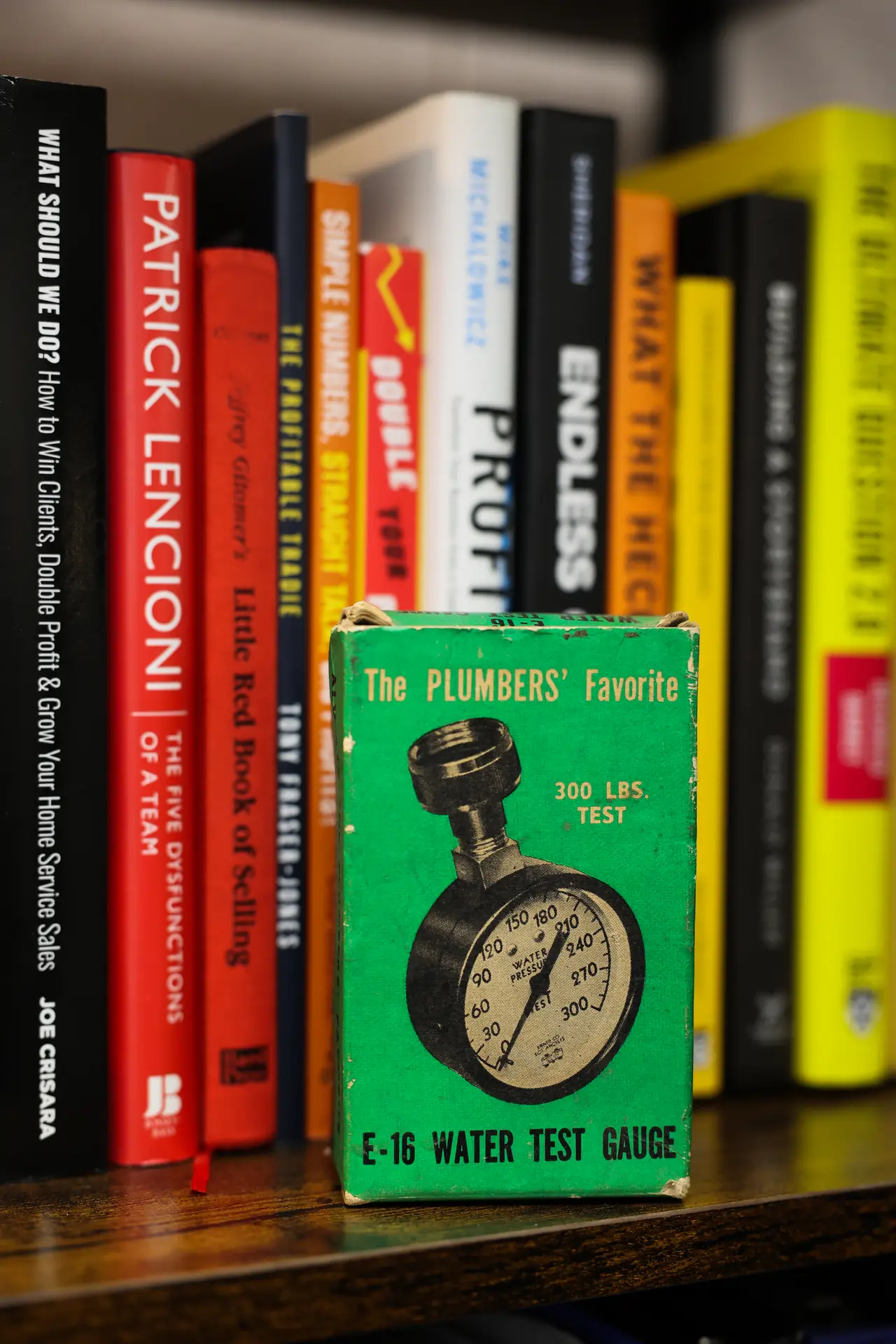
Learning how to test home water pressure gives you one useful number before you call a plumber. With an inexpensive threaded gauge and an accessible cold-water connection, you can measure the pressure entering the house and describe whether the problem is low, high, unstable, or limited to one fixture.
The test does not identify every cause by itself. A normal reading at an outdoor faucet can coexist with a clogged aerator, failing shower cartridge, restricted pipe, water heater issue, or pressure loss that appears only when several fixtures run.
Use the result as evidence, not as permission to turn adjustment screws or replace parts blindly. Drain Doctors provides water pressure service for Central Coast homes when testing points to a regulator, valve, service line, or distribution problem.
In this article, you will learn about:
- How do you test home water pressure accurately?
- What does your water pressure reading mean?
- How can you narrow down the cause before calling?
- What information should you give the plumber?
Keep reading to turn one gauge reading into a clearer description of what your plumbing system is doing.
How do you test home water pressure accurately?
The basic test uses a gauge with a female hose-thread connection. It can attach to an outdoor hose bibb, a cold-water washing machine valve, or another compatible cold-water outlet that is actually supplied by the home's domestic system.
Accuracy depends on preparation and test location. If irrigation is running, a toilet is filling, or the gauge is connected ahead of the home's pressure regulator, the number may not represent the pressure available to indoor fixtures.
Choose a gauge and the right test point
Select a water pressure gauge intended for household plumbing, with a readable psi scale and a washer in the threaded connection. A simple gauge gives the current reading, while a model with a maximum-reading pointer can capture short pressure peaks when used according to its instructions.
The best first test point is usually a hose bibb close to where the water service enters the building and downstream of any pressure-reducing valve. If that is not available, a cold washing-machine connection can work, but the valve and hose must be handled carefully to avoid a leak.
Before connecting the gauge, check:
- Whether the outlet is supplied by domestic water rather than a separate irrigation source.
- Whether the test point is before or after the pressure regulator.
- Whether the hose bibb, valve, and gauge washer appear intact.
- Whether the gauge range is high enough for household service pressure.
- Whether the connection can drain without damaging finishes or belongings.
Knowing the test point matters as much as knowing the number. A reading before the regulator reflects utility-side pressure at that location, while a reading after it is more useful for evaluating the pressure delivered to the house.
If you cannot identify the piping route or regulator location, stop at the accessible fixture test. A professional plumbing inspection can map the service entry, shutoffs, regulator, and branches without relying on guesswork.
Turn off water use before taking the static reading
Static pressure is the pressure measured when no water is intentionally flowing. Shut off faucets, showers, irrigation, dishwasher and washing-machine cycles, and any other known water use before attaching the gauge.
Wait for toilets and ice makers to finish filling. If a water softener, filtration system, or irrigation controller is scheduled to operate, pause the test until those cycles are complete rather than changing settings you may not know how to restore.
The U.S. Environmental Protection Agency gives the same basic method: turn off water-using fixtures and systems, attach a gauge to the hose bibb, and open the outlet fully. WaterSense says incoming pressure between 45 and 60 pounds per square inch generally supports efficient fixture and appliance operation.
Thread the gauge on by hand until the washer seals, then open the valve slowly and fully. If water sprays at the connection, close the valve, relieve the pressure, and reseat or replace the washer instead of tightening the gauge aggressively with a tool.
Record static, flowing, and repeat readings
Once the needle settles, record the static pressure, time, test location, and whether the reading holds steady. A photo of the gauge can help you compare later tests and show the plumber exactly what you observed.
Next, leave the gauge connected and have someone open a tub spout, shower, or other high-flow fixture. Record the pressure while water is moving, then close the fixture and watch how quickly the pressure returns to the static reading.
Use this sequence for a useful test record:
- 1Confirm that all water use is off and note the test point.
- 2Open the gauge connection fully and record the settled static pressure.
- 3Run one high-flow fixture and record the pressure under demand.
- 4Close the fixture and note whether pressure recovers quickly, slowly, or above the original reading.
- 5Repeat the test at another time of day if the complaint is intermittent.
Static and flowing readings answer different questions. A normal static number with a sharp drop under demand can suggest a restriction, undersized component, partially closed valve, failing regulator, or supply limitation rather than a simple low-pressure setting.
Do not leave an ordinary gauge connected indefinitely. If a plumber asks for an overnight or peak-pressure test, use equipment designed for that purpose and follow instructions for freeze protection, drainage, and safe removal.
What does your water pressure reading mean?
A pressure number needs context. The water provider, property elevation, meter, regulator, pipe size, building height, fixtures, and current demand all affect what the gauge shows.
Start with the measured pattern, then compare it with utility guidance and the home's behavior. Avoid treating one internet range as a diagnosis for every Central Coast property.
A reading around 45 to 60 psi is a useful baseline
EPA WaterSense recommends 45 to 60 psi for incoming residential service pressure. Within that range, most properly designed household fixtures should operate without exposing the plumbing system to unnecessary pressure.
That does not mean every outlet should feel identical. Elevation within the home, long pipe runs, small branches, valves, filters, cartridges, and simultaneous demand can reduce pressure at a particular fixture while the service-entry reading remains normal.
Compare cold water at several locations. If only one faucet is weak, faucet repair may involve an aerator, cartridge, stop valve, or supply line rather than the whole-house regulator.
A weak shower with normal pressure elsewhere can point toward the showerhead, cartridge, mixing valve, or branch. Targeted shower service is more appropriate than raising pressure to every fixture in the house.
Low pressure can be local, whole-house, or demand-related
A reading much below the EPA's preferred range deserves a second test before conclusions are drawn. Verify that the test outlet is fully open, the main customer valve is open, no large water use is active, and the gauge is not damaged.
The City of San Luis Obispo's utility guidance names four common low-pressure causes: debris in a faucet aerator, a partially closed property valve, restricted galvanized steel piping, and a worn or failed pressure regulator.
The pattern helps separate those possibilities. Low pressure at one sink suggests a local obstruction, while low pressure everywhere may point to the regulator, main valve, service line, supply condition, or widespread pipe restriction.
If pressure starts normal but drops when several fixtures run, note which combination causes the change. A plumber evaluating older piping can compare the demand pattern with pipe size, material, corrosion, and routing.
High or creeping pressure needs professional attention
High pressure can strain connectors, fixture seals, valves, toilet fill components, appliance hoses, and water-heating equipment. Symptoms may include banging pipes, brief surges, dripping relief valves, recurring fixture leaks, or a static reading that slowly climbs after water use stops.
An EPA service-pressure technical sheet notes that most U.S. plumbing codes require a pressure-regulating valve when supplied pressure exceeds 80 psi. It also explains that a regulator can create a closed system in which thermal expansion needs to be addressed.
Do not respond to a high reading by turning the regulator adjustment screw without knowing the valve condition, current setting, or expansion-control design. An old regulator can leak, stick, or fail when disturbed, and lowering the set point will not correct a failed expansion tank.
Check whether pressure rises after a water heater heating cycle. If the gauge creeps upward only while hot water is being produced, the plumber may need to evaluate thermal expansion and water heater components, not only the regulator.
How can you narrow down the cause before calling?
You do not need to disassemble plumbing to provide useful diagnostic information. Comparing locations, temperatures, timing, and demand can show whether the symptom is local or systemwide.
Keep each check reversible. Cleaning an accessible aerator is different from opening a regulator, water heater valve, wall, or buried service line.
Compare one fixture with the rest of the house
Test cold water at a nearby sink, another bathroom, and an exterior outlet. If the gauge reading is normal and most fixtures perform well, focus on the affected fixture and its local valves or supply lines.
A weak kitchen faucet can have sediment at the aerator or cartridge. If the faucet and drain area also show leakage, sink repair can address the complete assembly rather than changing whole-house pressure.
Toilets provide another clue because a restricted stop valve or failing fill valve can make the tank refill slowly even when the rest of the house has normal pressure. That symptom belongs in a focused toilet repair, not a regulator adjustment.
When every fixture changes at the same time, ask whether the utility is doing nearby work and whether neighbors are affected. A sudden whole-house drop may be external, while a gradual decline more often points toward a valve, regulator, treatment device, or pipe restriction on the property.
Compare hot water with cold water
If cold water pressure is normal but hot water is weak throughout the house, look beyond the service pressure. The restriction may involve the water heater shutoff, heat-trap components, sediment, connector sizing, distribution piping, or a mixing valve.
If both hot and cold are weak only at one fixture, the problem is likely closer to that outlet. If all hot and cold fixtures are weak, return attention to the service entry, regulator, main valve, treatment equipment, and service line.
Whole-house filters and softeners can create pressure loss when media, cartridges, valves, or bypass settings are restricted. Professional water treatment service can measure pressure before and after the equipment rather than assuming the municipal supply is low.
Do not open a pressurized filter housing without following its shutdown and depressurization procedure. A gauge comparison is useful precisely because it can reveal a likely restriction without taking equipment apart.
Check for leaks, valve position, and regulator behavior
Walk through the property for dripping fixtures, running toilets, damp walls, wet cabinets, irrigation problems, and unexplained meter movement. A leak can reduce pressure under demand and waste water even when the static gauge appears normal.
Use a short checklist before the service call:
- Confirm that the customer-side main valve is fully open without forcing it.
- Check whether the meter shows flow when all intended water use is off.
- Note any running toilet, dripping faucet, wet area, or appliance discharge.
- Watch whether static pressure creeps upward after fixtures close.
- Record whether the problem began suddenly or worsened over time.
EPA WaterSense suggests comparing water-meter readings across a two-hour period when no water is being used. A changed reading probably indicates a leak, and a family of four using more than 12,000 gallons in a winter month may have a serious leak.
If you find moisture but not the source, professional leak detection can help trace concealed water loss. If pressure disappears between the meter and the house, water line repair may require evaluation of the buried service route.
What information should you give the plumber?
Good notes can shorten the diagnostic process, but they do not replace testing with calibrated equipment. The plumber will still verify the pressure, inspect the regulator and valves, and compare conditions across the system.
Share the facts without deciding the repair in advance. "Pressure was 52 psi static and fell sharply when the tub ran" is more useful than "the regulator is bad."
Record the number, time, location, and demand
Write down each test point, the static reading, the flowing reading, the fixture used to create demand, and the time of day. Add photos or a short video if the needle fluctuates or climbs after flow stops.
Also report whether the issue affects hot water, cold water, one room, an upper floor, irrigation, or the entire house. Mention recent plumbing work, utility notices, water heater replacement, filter changes, leaks, or construction near the service line.
Bring this information to the call:
- Static and flowing pressure readings with times and locations.
- Which fixtures are affected and whether hot or cold water differs.
- Whether pressure changes at particular times or with simultaneous use.
- Whether the home has a regulator, well, softener, filter, or expansion tank.
- Any visible leak, running meter, pipe noise, or recent repair.
This record helps the plumber choose where to test first. It can also prevent a local fixture problem from being misdiagnosed as a whole-house pressure issue.
Keep the gauge photo even if pressure returns to normal. Intermittent regulator creep, utility variation, pump cycling, and high-demand pressure loss may not appear during a short service visit.
Municipal water and private wells behave differently
Municipal pressure can vary by elevation, pressure zone, storage level, and system demand. The City of Santa Maria says local water pressure is usually between 60 and 80 psi depending on property elevation, which may differ from the pressure measured after a home's regulator or treatment equipment.
That local range is a useful comparison, not a target for every fixture. A Santa Maria home may show a lower indoor reading because the customer-side regulator is doing its job.
Private wells cycle between pump-switch settings rather than holding one municipal supply pressure. Clemson University Cooperative Extension lists 20-40, 30-50, and 40-60 psi as common pressure-switch ranges, with the first number representing pump start and the second pump stop.
For a well system, record the cut-in and cut-out readings and whether the pump cycles rapidly. Do not change the switch or tank air charge unless you understand the system and have safely isolated electrical power and water pressure.
Know when testing should stop and service should begin
Call a plumber when pressure exceeds 80 psi, remains well below the useful range, drops sharply under modest demand, fluctuates without an obvious reason, or creeps upward after fixtures close. Recurring water hammer, relief-valve discharge, leaks, and sudden whole-house changes also deserve prompt attention.
Stop the test immediately if the gauge connection leaks heavily, a valve will not operate normally, a pipe begins moving, or water appears where it can damage the building. Use the customer shutoff only if you know which valve it is and can operate it without force.
Homeowners seeking plumbing help in San Luis Obispo should report whether the problem began throughout the neighborhood or only inside the property. That distinction helps separate utility conditions from customer-side work.
Do not operate the utility-owned street-side meter valve. If the issue appears to be before the customer shutoff or meter, contact the water provider and follow its instructions.
Conclusion
A hose-bibb gauge can tell you whether household pressure is low, high, stable, or changing under demand. The best test includes the location, time, static reading, flowing reading, and a comparison between fixtures.
Use those results to describe the problem rather than adjusting the regulator or replacing parts on a hunch. A professional can then evaluate valves, regulator performance, thermal expansion, leaks, restrictions, treatment equipment, and the water service line in the right order.
Drain Doctors helps Central Coast homeowners find the reason behind weak, excessive, or fluctuating water pressure and choose a repair that fits the actual system.
Contact Drain Doctors to schedule a home water pressure evaluation.