
Slow drains and stubborn clogs bring most San Luis Obispo homeowners to the same question: hydro jetting or snaking, and which one actually fixes the problem instead of just buying you a few more weeks. Both methods clear a blocked line, but they do it in completely different ways, and picking the wrong one can mean paying for a second visit a month later.
Drain Doctors Plumbing sees this decision play out every week during routine drain cleaning calls, from kitchen sinks clogged with grease to main lines choked by tree roots along older streets in town. The right call depends on what's actually causing the clog, how old the pipe is, and whether this is a one-time problem or something that keeps coming back.
This guide breaks down what each method does, when one makes more sense than the other, and how a professional plumber decides between them on a real job. By the end, you'll know enough to have an informed conversation with your technician instead of just taking whatever's offered first.
In this article, you will learn about:
- What hydro jetting is and how it clears a drain
- What snaking is and where it works best
- How a plumber decides which method fits your clog
- What happens if you pick the wrong method for your pipes
Keep reading to find out which method actually solves your drain problem instead of just delaying it.
What hydro jetting actually does to a clogged pipe
Hydro jetting uses a hose fitted with a specialized nozzle that sprays pressurized water in multiple directions at once. The forward jets blast a path through whatever is blocking the line, while the rear-facing jets scour the pipe walls as the hose moves through, stripping away buildup rather than just punching a hole in it.
That full-wall cleaning is the entire point of the method, and it's what separates it from a quick mechanical fix.
Why full-wall cleaning matters more than clearing a path
A clog rarely sits in one tidy lump. Grease, soap scum, and mineral scale coat the inside of the pipe over months or years, narrowing the usable width long before anything fully blocks the line. Jetting removes that coating instead of just clearing a channel through the middle of it.
- Grease and soap buildup coating the pipe interior
- Mineral scale from hard water deposits
- Tree root intrusion inside the line
- Recurring sludge in main sewer lines
Each of these builds up gradually, which is part of why homeowners are often surprised by how much material comes out of a line that seemed to be draining fine just weeks earlier.
Because jetting cleans the full diameter rather than a narrow path, the results tend to last considerably longer than a quick mechanical fix. That's part of why it costs more upfront. You're paying for a cleaner pipe, not just an open one.
The pressure range and why it varies by pipe
Hydro jetting typically runs at pressures between 1,500 and 4,000 PSI depending on the pipe material and the severity of the buildup. That range gives a plumber room to match the pressure to the pipe rather than blasting every line the same way.
A newer PVC line in good condition can usually take the higher end of that range without issue. An older, more fragile pipe calls for a gentler setting, or in some cases rules out jetting altogether until repairs happen first.
- 1Assess the pipe material and general condition
- 2Select a pressure setting appropriate to that pipe
- 3Run the jetting pass and monitor water return
- 4Adjust pressure mid-job if the line reacts unexpectedly
This is also why a professional job looks different from a rental jetting kit. A trained technician reads what the pipe is telling them as they work, not just running one fixed setting from start to finish.
Why a camera inspection almost always comes first
A technician doesn't jet blind. A camera inspection almost always comes first, since the pressure that safely clears a sound cast iron or PVC line can worsen damage in a pipe that's already cracked, corroded, or offset at the joints.
That inspection step matters more in older neighborhoods, where clay and cast iron lines from decades past sit alongside newer PVC. San Luis Obispo has plenty of both, and knowing which one you have changes the entire plan before any water gets turned on.
- Camera inspection confirms pipe material and condition
- Nozzle and hose feed into the line at the cleanout
- Pressurized water clears the blockage and scours the walls
- A second camera pass confirms the line is fully clear
Skipping this step to save time is one of the more common mistakes in DIY drain cleaning attempts, and it's a large part of why professional jetting looks so different from a rented machine at a hardware store.
What snaking is and where it earns its keep
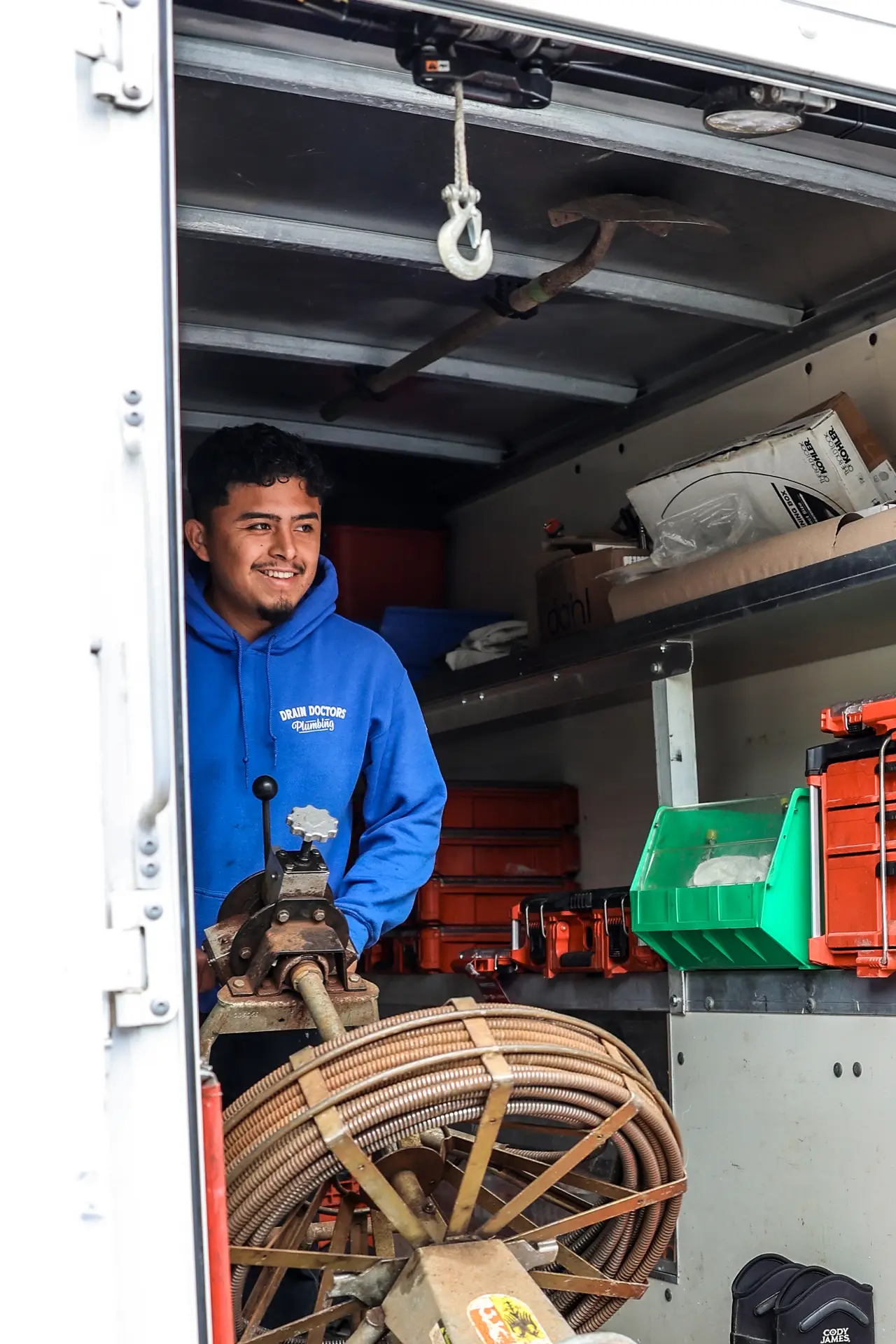
A drain snake, sometimes called a plumber's auger, is a long, flexible metal cable fed into the drain by hand or with a motorized drum. The cable either punches straight through the blockage or hooks onto it so the technician can pull the material back out.
It's one of the oldest tools in the trade, and it's still the right call for a large share of everyday clogs.
The clogs snaking handles well
A hair clog in a bathroom sink, a wad of paper towels stuck a few feet into the line, a single isolated obstruction near the drain opening: snaking handles these quickly and at lower cost than jetting.
- Hair and soap clogs in bathroom drains
- Isolated food debris in kitchen lines
- Paper products lodged near the drain opening
- Quick clearing when a line needs to flow again today
Snaking works best when the clog sits within the first 25 feet of pipe and involves something solid enough to grab or break apart. It's a targeted tool for a specific job, not a full cleaning method, and there's nothing wrong with reaching for it when the situation calls for exactly that.
For a lot of everyday clogs, this is genuinely the faster and cheaper answer, and it gets the water moving again without the setup time hydro jetting requires.
What a snake leaves behind
The tradeoff is what a snake leaves behind. Because the cable punches or pulls rather than scours, it often leaves a coating of grease or scale along the pipe walls even after the immediate blockage clears. That residue gives the next clog somewhere to start building.
That's why snaked drains sometimes back up again within a few months, especially in kitchen lines that see regular grease and food debris. The clog itself is gone, but the conditions that caused it are still sitting on the pipe walls waiting for the next buildup.
- 1Cable clears or pulls the immediate obstruction
- 2Water flow returns, often within minutes
- 3Residual buildup remains coating the pipe walls
- 4That residue can start a new clog weeks or months later
None of that makes snaking the wrong choice for the situations it's built for. It just means the method has limits worth knowing before you commit to it as a repeat fix for a repeat problem.
When snaking is the honest right answer
Sometimes the simple, cheaper method really is the correct one, and that's worth saying plainly rather than always steering toward the more expensive option. A single recent clog in a young, structurally sound pipe rarely needs the full jetting treatment.
- A first-time clog with no history of recurrence
- A clog isolated to one fixture rather than a shared line
- A pipe confirmed sound through a recent inspection
- A budget-conscious homeowner facing a straightforward blockage
A good technician will say so directly rather than upselling a bigger job than the situation calls for.
How a plumber actually decides between the two
The decision rarely comes down to a fixed rule. A technician weighs the clog's location, the pipe's age and material, how often the problem has happened before, and what the camera inspection actually shows once the line is opened up.
Reading the pattern of recurring clogs
Recurring clogs are the biggest signal that snaking alone won't solve anything long term. If the same kitchen line has backed up three times this year, snaking it a fourth time just resets the clock on the same buildup. That pattern usually means grease or scale has coated the pipe walls, and only a full jetting pass removes it.
Grease is a recurring theme here, and it isn't just a kitchen-sink inconvenience. The U.S. Environmental Protection Agency has identified grease from restaurants, homes, and industrial sources as the most common cause of reported sewer blockages nationally, responsible for roughly 47 percent of them. That's the kind of buildup jetting is built to remove and snaking tends to leave behind.
- A single recent clog in a younger, sound pipe usually points to snaking
- Recurring clogs or heavy grease buildup usually point to jetting
- A fragile or older pipe may rule out jetting until repairs are made
- Tree root intrusion often calls for jetting to clear roots and restore flow
Weighing pipe age and material against the fix
Pipe condition is the other half of the equation, and it's the half homeowners often can't see for themselves. Older clay or cast iron lines can be structurally weaker than they look from the outside, and full-pressure jetting on a compromised pipe can turn a clog into a leak.
- 1Confirm the clog type through symptoms and history
- 2Run a camera inspection before committing to either method
- 3Match the method to the pipe's actual condition
- 4Explain the tradeoffs so the homeowner understands the choice
This is also where local housing age matters. San Luis Obispo has a mix of newer construction and homes with original clay or cast iron sewer laterals still in the ground, and that mix is exactly why a camera inspection changes the plan rather than being a formality.
Why root intrusion changes the calculation
Root intrusion deserves its own mention because it's such a common culprit in older parts of town. Roots work through pipe joints and small cracks looking for moisture, and once inside, they spread into a mesh that traps debris and slows flow long before anyone notices a full blockage.
Nationally, the Environmental Protection Agency estimates that somewhere between 23,000 and 75,000 sanitary sewer overflows occur every year in the United States, with blockages from causes like roots, grease, and debris among the leading drivers. A line already narrowed by root intrusion is a poor candidate for snaking alone, since the cable can punch a path through the root mass without actually clearing it.
- Roots enter through joints, cracks, or loose seals
- A root mass traps grease, debris, and paper products
- Jetting cuts through roots and flushes the fragments out
- Snaking alone often leaves root fragments to regrow quickly
For a line with confirmed root intrusion, jetting combined with a camera follow-up tends to be the more durable answer, even though it costs more than a single snaking visit.
What happens when the wrong method gets used
Using a snake on a problem that needed jetting doesn't damage anything, but it does waste money. If the real issue is a grease-coated line or root intrusion throughout the pipe, snaking clears the immediate blockage and leaves the underlying cause completely untouched.
The callback cycle from an undertreated clog
That's the scenario that leads to a callback a few weeks or months later for what looks like the exact same clog. It isn't a new problem. It's the same buildup finishing the job it started, because nothing removed it the first time around.
- Wasted cost from repeat service calls on the same recurring clog
- A false sense that the plumbing problem is somehow unusual or unlucky
- Delayed detection of a bigger issue hiding behind the surface clog
- Frustration when "the same fix" stops working after a few tries
Breaking that cycle usually just means treating the actual cause once, rather than treating the symptom repeatedly.
The bigger risk of overtreating a fragile pipe
The bigger risk runs the other direction: jetting a pipe that can't handle the pressure. Full-pressure water against a cracked, corroded, or severely offset pipe can widen an existing weak point instead of just clearing debris, turning a manageable clog into a leak or a section that needs replacement.
- 1A weak or damaged section takes on full-pressure water
- 2Existing cracks or corrosion widen under that pressure
- 3What started as a clog becomes a structural repair
- 4The repair costs far more than the original service call
This is exactly why a camera inspection isn't an upsell tactic. It's the step that tells a technician whether the pipe in front of them can safely take high pressure, or whether a gentler approach is the smarter call for now.
Matching the method to the actual problem
Homeowners sometimes assume the more expensive method is automatically the better one, or that the cheaper method is always the safe default. Neither assumption holds up once you're looking at a specific pipe with a specific history.
- Cost alone doesn't tell you which method is correct
- Pipe age and material narrow the safe options
- Clog history reveals whether the cause was fully removed
- A camera inspection is usually the deciding factor either way
The method has to match the problem, not the other way around, and that match is exactly what a proper inspection is meant to reveal before any work starts.
Conclusion
Hydro jetting and snaking aren't competing methods so much as two different tools built for two different jobs. Snaking is fast, affordable, and genuinely the right call for a simple, isolated clog in a sound pipe. Hydro jetting earns its higher cost by fully cleaning the pipe wall, which matters most for recurring buildup, grease-heavy kitchen lines, and root intrusion.
The honest answer to which one you need almost always comes down to what a camera inspection shows, not a guess based on symptoms alone. A clog that looks minor from the kitchen sink can trace back to a much bigger buildup further down the line, and a pipe that looks fine on paper can be too fragile for full-pressure water without a closer look first.
If your drains keep backing up, or you're dealing with a clog that snaking hasn't fully solved before, it's worth having someone actually look at the pipe before choosing a method. Drain Doctors Plumbing can inspect the line, explain what's really going on, and recommend whichever method actually fixes it for good.