
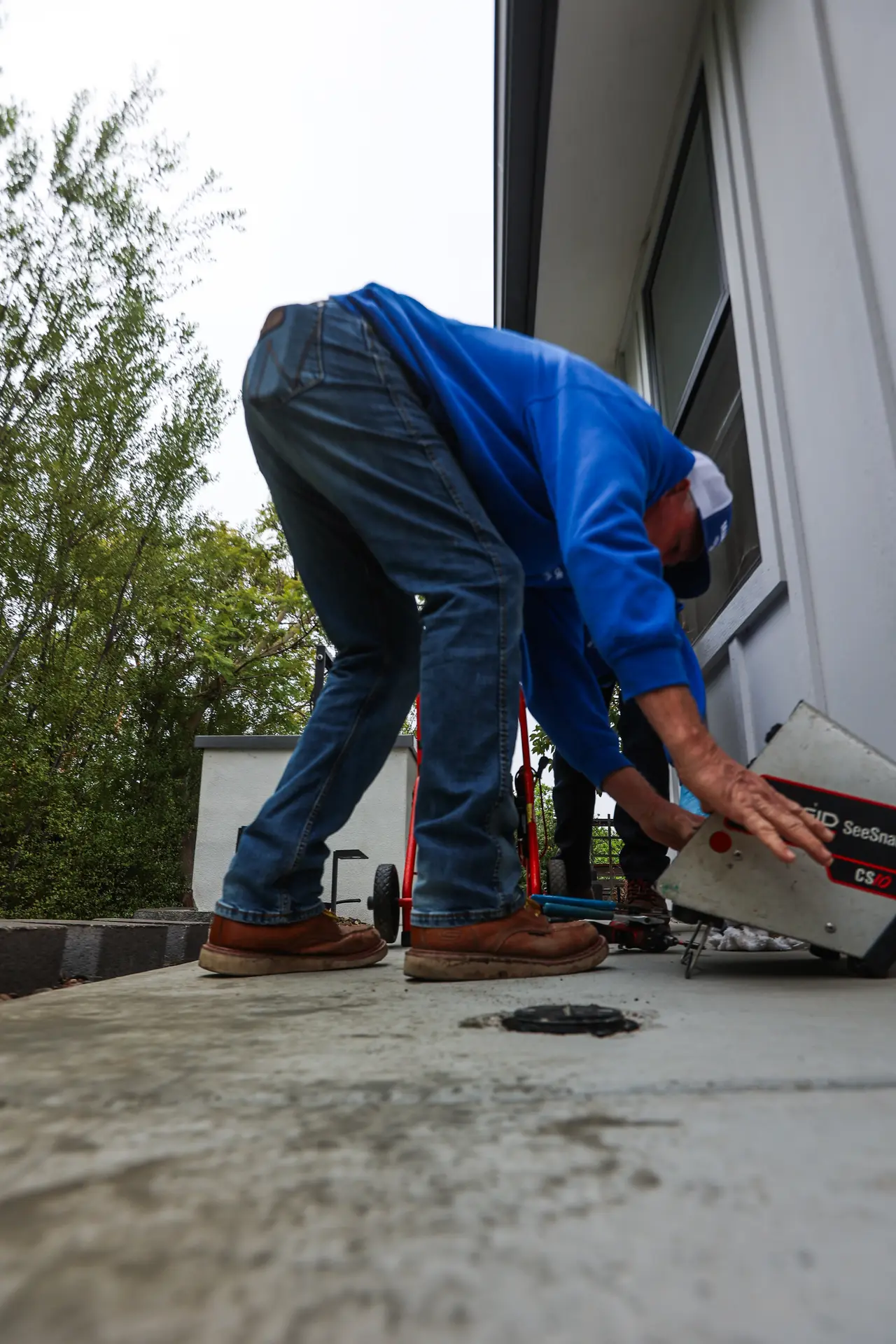
If your San Luis Obispo or Santa Maria home was built before the 1980s, there's a good chance you've heard some version of this warning: hydro jetting can blow out an old pipe. That concern isn't baseless, but it's also not the full picture. The real answer depends on what the pipe is actually made of and what condition it's in, not simply how old the house is.
Homeowners with older homes are right to ask this question before agreeing to any drain service. A pipe that's been in the ground for 60 or 70 years has had a lot of time to develop weak spots, and high pressure water finds weak spots fast. The good news is that this is a solvable problem, not a reason to avoid jetting altogether.
This article covers which pipe materials handle jetting well and which ones need caution, why a camera inspection is the step that actually determines safety, and what to ask a plumber before agreeing to have your older line jetted.
In this article, you will learn about:
- Which pipe materials hold up well under hydro jetting
- Why age alone doesn't determine whether jetting is safe
- What a camera inspection reveals before the water turns on
- Questions worth asking before scheduling a jetting service
Keep reading to find out whether your home's specific plumbing is a good candidate, and what happens if it isn't.
Which pipe materials matter most for jetting safety
Not all older pipe is created equal, and the material running under your home tells you far more about jetting safety than the year the house was built. Some materials handle high pressure water without issue even after decades in the ground. Others become genuinely risky once they've aged past a certain point.
Cast iron and clay are the two materials that come up most often in this conversation, and for good reason. Both were standard in residential construction for much of the twentieth century, and both are common throughout older neighborhoods in San Luis Obispo and Santa Maria. Neither is automatically unsafe to jet, but both deserve a closer look before anyone turns on the water. The installation era matters here too. An EPA WaterSense archive citing American Water Works Association data notes that cast iron pipe laid in the late 1800s often lasts 120 years, while pipe from the years right after World War II tends to wear out closer to 75 years, meaning a lot of Central Coast homes built in that postwar boom are now within range of their expected pipe lifespan.
- Cast iron: durable but prone to internal corrosion and scaling as it ages
- Clay (vitrified clay pipe): rigid and long lasting, but joints can shift and crack over decades
- Orangeburg (bituminous fiber pipe): the material that deserves the most caution, common in homes built roughly midcentury
- PVC and ABS: modern materials that generally handle jetting well regardless of age
- Copper and cast iron supply lines: not typically jetted, since jetting applies to drain and sewer lines
Why Orangeburg pipe is the material to watch for
Orangeburg pipe, sometimes called bituminous fiber pipe, was manufactured from layers of wood pulp and pitch and installed widely in residential construction from the 1940s through the 1970s. It was inexpensive and easy to work with at the time, but it has not aged well, and it's the one material where jetting genuinely deserves extra caution regardless of the specific home.
The problem with Orangeburg isn't corrosion in the traditional sense. The material physically breaks down over time, losing structural integrity and sometimes deforming into an oval shape under soil pressure. A camera inspection that reveals Orangeburg pipe usually leads to a very different conversation than one that reveals sound cast iron or clay.
- 1Camera inspection identifies Orangeburg by its distinctive appearance and texture
- 2A technician evaluates how much structural integrity remains before considering jetting
- 3Severely deteriorated Orangeburg typically calls for replacement rather than any drain service
- 4Sound sections in otherwise good condition may tolerate a conservative, low pressure approach
How cast iron ages differently than clay
Cast iron pipe fails in a different way than clay does, and understanding that difference helps explain why the same jetting service can be perfectly safe in one home and risky in another. Cast iron corrodes from the inside out, gradually thinning the pipe wall until it becomes brittle or develops holes.
Clay pipe, by contrast, tends to stay structurally sound for the pipe itself while the joints between sections are where problems show up. Ground movement, root intrusion, and decades of soil pressure can shift or crack those joints even when the clay sections on either side remain solid. A camera inspection distinguishes between these failure patterns immediately, which is exactly why it matters so much before jetting begins.
What a technician looks for in a pre-jetting camera pass
A technician evaluating an older line for jetting isn't just checking whether water flows. The camera pass is a deliberate inspection with a specific goal: confirm the material, map any existing damage, and decide whether high pressure water is the right tool for this particular pipe on this particular day.
That inspection typically starts at the nearest cleanout and works methodically through the accessible sections of the line. Any drain cleaning service on an older home should include this step as a matter of course, not as an upsell tacked onto the visit.
- Confirming pipe material along the full length of the accessible line
- Noting the location of any joints, since that's where clay pipe problems concentrate
- Checking for consistent pipe diameter, since narrowing can indicate scale or root intrusion
- Flagging any section that looks structurally different from the rest of the run
Why age alone doesn't determine whether jetting is safe
It's tempting to use a home's age as a shortcut for deciding whether jetting is safe, but that shortcut misses the actual variable that matters. Two homes built in the same year, on the same street, can have dramatically different pipe conditions depending on soil composition, root activity, prior repairs, and simple luck.
A pipe's real condition is shaped by what has happened to it over decades, not just how much time has passed. Tree roots near one home's sewer line and none near the neighbor's can mean one line is riddled with cracks and the other is essentially intact, despite identical construction dates. This is the core reason jetting decisions should never be made off a home's age alone.
- Soil type and moisture levels affect how quickly pipe deteriorates underground
- Nearby tree roots accelerate cracking and joint separation regardless of pipe age
- A prior repair or partial pipe replacement can mean parts of the line are much newer than others
- Ground settling and seismic activity, both relevant to the Central Coast, stress pipe joints over time
This isn't theoretical for California. After the 1989 Loma Prieta earthquake, the U.S. Geological Survey documented that liquefaction in San Francisco's Marina District required 123 repairs to the municipal water system's pipelines, more than three times the repair rate seen elsewhere in the system, and more than 20 percent of the area's wastewater collection lines needed repair or replacement. Ground movement alone can compromise a pipe that jetting itself never touched.
What actually happens when jetting hits a genuinely weak pipe
Understanding the real risk helps put this in proper perspective. High pressure water directed at a structurally sound pipe wall, regardless of material or age, cleans without causing damage. The risk only appears when the pipe already has a crack, a significant corrosion thin spot, or deteriorated material like failing Orangeburg.
In those specific situations, water pressure can widen an existing crack, blow through a thin corroded spot, or physically break apart material that was already failing. This is precisely why the inspection step isn't a formality. It's the entire mechanism that separates a safe jetting job from a risky one.
- 1Sound pipe wall: high pressure water cleans effectively with no structural risk
- 2Existing crack or joint separation: water pressure can worsen the damage already present
- 3Significant corrosion thinning: a thin spot can fail under pressure that a healthy wall would handle easily
- 4Deteriorated Orangeburg: material breakdown means even moderate pressure carries real risk
Why a technician adjusts pressure and nozzle choice for older lines
Jetting isn't a single fixed setting applied the same way to every pipe. An experienced technician adjusts water pressure and selects a nozzle type based specifically on what the camera inspection reveals about the line's material and condition.
A newer PVC line in excellent condition can typically handle a more aggressive setting than a sound but aging clay line, and a sound clay line can handle more than a line showing early corrosion or joint wear. This calibration is exactly what separates careful commercial-grade work from a one-size-fits-all approach that treats every pipe the same regardless of what's actually underground.
When the safer call is repair before any jetting happens
Sometimes the camera inspection makes the decision easy in the other direction. A section with a visible crack, a significantly offset joint, or advanced corrosion thinning isn't a candidate for a careful jetting approach. It's a candidate for repair first.
Trying to jet around a known weak spot, even at reduced pressure, still puts water directly against material that may not hold up. A pipe repair that addresses the specific compromised section turns a risky jetting job into a safe one, since the line that comes out the other side is the one actually getting cleaned.
- A short, targeted repair section is often less invasive than homeowners expect
- Repairing the weak point first protects the rest of an otherwise sound line
- Jetting after repair can proceed with a normal pressure setting instead of an overly cautious one
What a camera inspection reveals before the water turns on
A sewer camera inspection is a small waterproof camera fed through the line before any jetting work begins, and it is the single step that makes an informed safety decision possible. Skipping this step and jetting blind is the actual risk here, not the age of the home itself.
The camera shows the technician exactly what material the pipe is made from, where any cracks or joint separations exist, how severe any corrosion or deterioration has become, and whether there are sections that call for a different approach than the rest of the line. Without that information, a technician is essentially guessing, and guessing with high pressure water on an unknown pipe is not a reasonable way to operate.
- Pipe material identification, including catching Orangeburg before it's too late to plan around
- Location and severity of any existing cracks or joint separation
- Corrosion thinning in cast iron sections, visible as texture and color changes on camera
- Root intrusion points that may indicate a compromised joint underneath
Reading the difference between routine wear and a real problem
Not everything a camera reveals is cause for concern. Some scale buildup, minor staining, and cosmetic wear are completely normal in an older line and don't change the jetting decision at all. The skill in reading a camera inspection is telling the difference between routine wear and an actual structural concern.
A technician experienced with older Central Coast homes has usually seen enough clay and cast iron lines to make that call quickly and confidently. That experience matters as much as the equipment itself, since two technicians looking at the same footage should generally reach the same conclusion about whether a line is a good jetting candidate.
- 1Cosmetic scale and staining: normal, doesn't affect the jetting decision
- 2Minor root hair intrusion at a joint: often still jettable with appropriate care
- 3Visible cracking or significant joint offset: calls for a more conservative approach or repair first
- 4Severe corrosion thinning or deteriorated Orangeburg: usually a repair or replacement conversation instead
When the inspection reveals a line that shouldn't be jetted at all
Sometimes a camera inspection reveals a line in poor enough condition that jetting isn't the right call regardless of pressure or nozzle choice. This isn't a failure of the process. It's the process working exactly as intended, catching a problem before it becomes a much bigger and more expensive one.
A severely compromised section usually points toward targeted pipe repair rather than any drain service. An honest technician explains this clearly rather than jetting anyway and hoping for the best, since a line that fails during jetting turns a routine maintenance visit into an emergency repair.
Why root intrusion findings need extra scrutiny on older lines
Root intrusion shows up constantly in older clay and cast iron lines, and not every instance means the same thing. Fine root hairs at a single joint are a very different finding than a dense root mass that has worked its way through a significantly compromised section of pipe.
The distinction matters because jetting handles these two situations differently. A minor root intrusion point often clears with standard jetting and leaves the joint intact enough to hold. A joint that's already failed structurally, with roots simply exploiting the gap, may need repair regardless of how well the jetting itself goes.
- Fine root hairs at an otherwise sound joint: typically resolves with standard jetting
- A dense root mass with visible joint separation on camera: often needs repair alongside or instead of jetting
- Recurring root intrusion at the same spot despite repeated jetting: a sign the joint itself has failed
- Root intrusion combined with any visible pipe deformation: warrants a repair conversation first
Questions worth asking before scheduling a jetting service
A short set of questions before booking a jetting service tells you quickly whether you're dealing with a company that takes older pipe seriously or one that treats every job the same way. Any technician confident in their process should answer these directly without hesitation.
Asking about the inspection process itself is the most important question of all. A company that jets first and inspects only if something goes wrong is operating backward, and that approach carries real risk for a home with pipe of unknown age or condition.
- Will a camera inspection happen before jetting begins on my line
- What pipe material does my home have, and does that change the approach
- What pressure setting is planned, and why is that the right choice for my specific pipe
- What happens if the inspection reveals a section that shouldn't be jetted
What a trustworthy answer sounds like
A technician who takes older pipe seriously will walk through the inspection process without prompting, explain what they're looking for on camera, and describe how findings would change their approach. Vague reassurance that "we jet everything the same way" or "it'll be fine" without mentioning inspection at all is a signal worth taking seriously in the other direction.
The most reassuring answer is often the most specific one. A technician who can describe how they'd handle a hypothetical crack or corroded section, rather than just asserting that jetting is always safe, is demonstrating the kind of judgment that actually protects an older home's plumbing.
What to do if you're told your pipe isn't a good jetting candidate
Hearing that your line isn't a good fit for jetting isn't bad news delivered badly. It's useful information that saves you from a service that could have made things worse. The right next step depends on what the inspection actually found.
A section with isolated cracking or joint separation may call for targeted repair, after which jetting becomes a reasonable option again. A more extensively deteriorated line, particularly Orangeburg pipe past its structural limit, more often points toward a larger conversation about repair or replacement rather than any drain service in the near term.
- 1Review the camera footage with the technician so you understand exactly what was found
- 2Ask whether a targeted repair would resolve the issue enough to make jetting viable later
- 3Get a clear picture of urgency, since not every finding requires immediate action
- 4Avoid any company willing to jet a line they've already flagged as a poor candidate
Getting a second opinion when something feels off
If a technician recommends immediate full replacement without much explanation, or seems reluctant to show camera footage, a second opinion is a reasonable next step. Most legitimate findings hold up under a second look, and a second inspection rarely hurts.
An inspection that genuinely found a serious problem will look the same to any competent technician reviewing the same footage. Getting a second read costs little and protects against being pushed into unnecessary work on an older home's plumbing.
- A second camera review of the same footage often resolves uncertainty quickly
- Genuine structural problems look consistent across different technicians' assessments
- A company confident in its findings should welcome a second opinion, not discourage one
Conclusion
The honest answer to whether hydro jetting is safe for older pipes is that it depends on the pipe, not the calendar. Sound clay, well maintained cast iron, and modern PVC all typically handle jetting without issue, while deteriorated Orangeburg or a pipe with existing structural damage genuinely calls for caution or a different approach altogether.
A camera inspection is what actually answers this question for your specific home, and any technician who skips that step is asking you to trust a guess rather than an informed decision. That's the real distinction worth paying attention to, far more than the age of the house itself.
If you're wondering whether your San Luis Obispo or Santa Maria home's pipes are a good fit for hydro jetting, Drain Doctors can run a camera inspection first and give you a straight answer based on what's actually down there. Reach out to Drain Doctors to get started.