
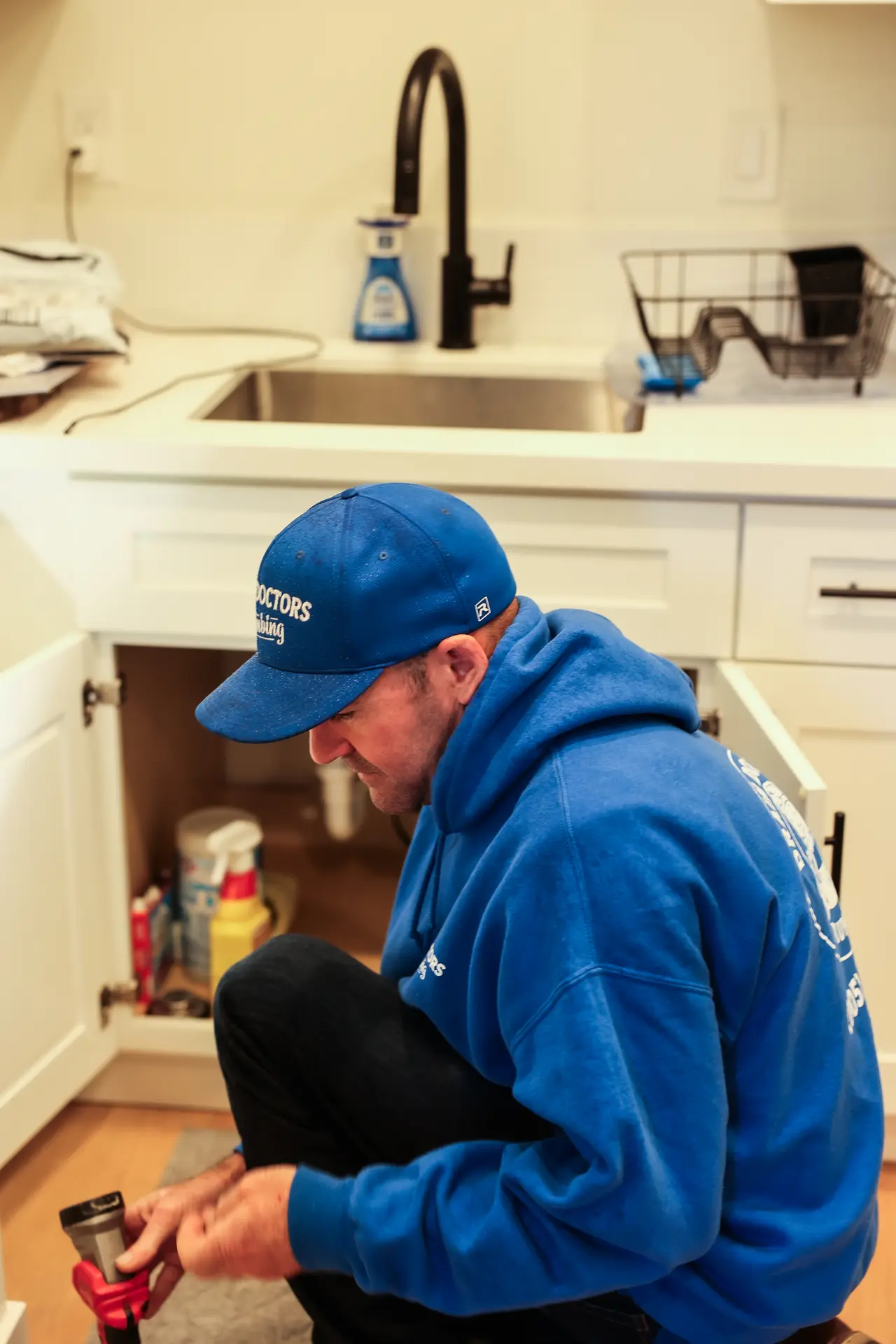
A kitchen sink that won't drain, or worse, sends water and food scraps back up right when you're mid-meal prep, is one of the more frustrating plumbing problems a San Luis Obispo homeowner can face. It rarely happens out of nowhere. Something specific is narrowing or blocking the line, and the way it's backing up usually points straight to what that something is.
Most people's first instinct is to reach for a plunger or a bottle of drain cleaner and hope for the best. Sometimes that works, at least for a while. A sink that keeps returning to the same problem, though, is telling you something the quick fix isn't addressing, and understanding what's actually happening in the pipe changes how you deal with it, both today and the next time it happens.
This guide walks through the most common reasons a kitchen sink backs up, how to tell a simple, local clog from a bigger plumbing problem, and what homeowners often try that quietly makes things worse rather than better. By the end, you'll have a much better sense of what's likely going on under your own sink.
In this article, you will learn about:
- The most common causes of a backed-up kitchen sink
- How to tell a simple clog from a bigger plumbing problem
- What homeowners try that often makes things worse
- When a backup means something beyond your kitchen line
Keep reading to figure out what's actually blocking your drain and what actually fixes it.
The usual suspects behind a backed-up sink
Kitchen sink backups trace back to a small handful of repeat offenders, and once you understand how each one behaves inside the pipe, the pattern in your own kitchen usually becomes easy to recognize.
Grease and cooking fat
Grease is, by a wide margin, the single biggest culprit. It goes down the sink as a warm liquid after cooking, whether from a pan of bacon, a roasting dish, or a sauce with a heavy fat content, and it looks harmless enough sliding off the plate. The problem starts once it hits the cooler water and pipe walls further down the line. Grease cools and hardens as it travels, clinging to the inside of the pipe rather than continuing on with the water.
Every subsequent rinse adds a little more to that coating, and because each individual pour looks so small, most homeowners never connect months of ordinary dishwashing to a pipe that's now noticeably narrower than it used to be. By the time a full clog forms, the buildup usually didn't happen overnight. It happened one dinner at a time, a little grease from tonight's pan joining what was already sitting there from last week.
Food particles and garbage disposal habits
Garbage disposals complicate this picture rather than solving it, since a lot of homeowners assume that if the disposal is running, whatever goes down is genuinely gone. In reality, a disposal only grinds food into smaller pieces. It doesn't dissolve them or push them especially far, and certain foods behave badly once they're through the blades.
Fibrous vegetables like celery and asparagus tend to wrap around the blades instead of breaking apart cleanly. Coffee grounds settle into a dense, sludge-like layer wherever the pipe bends. Starchy foods like rice and pasta keep absorbing water and expanding well after they've already gone down the drain, and eggshells or small bone fragments add abrasive material that resists grinding altogether.
None of this necessarily jams the disposal itself. It just means the material makes it past the unit and starts accumulating in the trap or the horizontal run of pipe leading toward the main line, which is exactly where a slow, gradual backup tends to start. If the fixture itself isn't properly sealed where it meets the sink, that only makes the problem worse.
A poorly sealed fixture installation can leave small gaps where debris catches instead of flushing cleanly through, giving grease and food particles somewhere to start building a foothold before they ever reach the main line.
Soap scum and hard water buildup
Dish soap on its own rinses away without much trouble, but combined with mineral-heavy water, it forms a scum that clings to pipe walls in much the same way grease does, just more gradually. This kind of buildup rarely causes a sudden backup by itself.
Its real danger is what it quietly sets up: a slicker, narrower pipe that grease and food debris latch onto far more easily than they would in a clean line. By the time a homeowner notices anything, the soap scum has often been narrowing the pipe for months, largely invisible, and it's usually the last straw of grease or food debris that finally tips things into a full backup rather than the soap scum itself.
Telling a simple clog from a bigger problem
Not every kitchen sink backup is the same kind of problem, and the way it shows up usually tells you a lot before a plumber ever gets involved.
When it's isolated to the kitchen sink
If the backup is confined entirely to the kitchen sink, with nothing else in the house draining slowly or acting up, that's the more common and more easily resolved version of this problem. Water backs up specifically when the kitchen sink runs, the disposal turns on fine but doesn't clear anything, and every other bathroom or laundry drain in the house continues behaving normally.
This pattern points to a clog sitting somewhere between the sink drain and the point where the kitchen line joins the rest of the home's plumbing. A plunger or a basic drain snake often resolves it without much drama, precisely because the problem is local rather than shared with the rest of the house.
When multiple fixtures are affected
A backup that spreads beyond the kitchen tells a very different story. If the kitchen sink starts backing up around the same time a bathroom drain slows down, or if running the kitchen faucet causes gurgling somewhere else in the house, that pattern usually means the real blockage sits further downstream in a line the kitchen shares with other fixtures.
The same holds for a floor drain or laundry line acting up alongside the kitchen, or backups that seem to worsen right after a period of heavy household water use, like a full load of laundry running at the same time as the dishwasher. When symptoms spread like this, treating it as a simple kitchen clog usually means it comes right back, since the actual blockage was never reached in the first place.
Warning signs that point to something more serious
A few signs suggest the problem goes beyond a typical grease or food clog, and they're worth taking seriously the first time they show up rather than after the third repeat visit.
- A sudden, complete stoppage rather than a gradual slowdown over days or weeks
- Sewage odor accompanying the backup
- A backup that returns within days of being cleared, no matter how thoroughly
A sudden, complete stoppage suggests something more abrupt than typical buildup, like a solid object or a significant root mass. Sewage odor often means wastewater isn't moving the way it should further down the line. And a backup that returns quickly is telling you plainly that whatever caused it wasn't actually removed the first time. Any one of these is a good reason to have the line properly inspected rather than repeating the same fix and hoping for a different result.
What homeowners try that often makes things worse
When a sink backs up, the instinct is to reach for whatever's under the counter, and some of those instincts genuinely help while others quietly make the underlying problem worse over time.
Chemical drain cleaners
Chemical drain cleaners are the classic example. They promise a fast fix, and to be fair, they sometimes deliver one, at least for a minor, isolated clog near the surface. The tradeoff is what repeated use does to the pipe itself.
Harsh chemical formulas can corrode older metal pipes over time, and the heat some of these products generate as they react can soften or warp certain pipe materials, particularly in an older home. There's also the practical problem of what happens when a chemical treatment doesn't fully clear the clog: caustic liquid is left sitting in the line, which complicates things considerably if a plumber ends up needing to work on that pipe by hand afterward.
Using a chemical cleaner once, on a clog you're fairly confident is minor, isn't necessarily dangerous. Reaching for it every time a sink slows down, though, tends to trade a quick fix now for a bigger and more expensive problem down the road.
Overusing the garbage disposal as a catch-all
Overusing the garbage disposal follows a similar pattern of good intentions creating a worse outcome. Running the disposal without water flowing first, grinding a large volume of food waste all at once, or regularly sending fibrous and starchy foods through it are all habits that seem harmless in the moment but add up the same way grease does.
A disposal used more carefully, with cold water running throughout and smaller amounts of appropriate food waste at a time, causes noticeably fewer downstream problems than one treated as a general-purpose disposal for anything that happens to fit down the drain.
Ignoring a slow drain until it fully stops
The last habit worth calling out is simply waiting too long. A kitchen sink rarely goes from perfectly fine to completely blocked overnight. It slows down gradually first, and that gradual slowdown is easy to write off as a normal quirk of an older house rather than an early warning sign.
Waiting until the sink stops draining entirely usually means significantly more material has accumulated by the time anyone calls for help, compared to addressing a slow drain as soon as it's noticed. It's also worth knowing that a properly installed drain line isn't just clean, it's correctly sloped, since a line that's too flat lets water and debris sit rather than move along as intended.
Federal plumbing construction standards for drain piping call for a slope of roughly a quarter inch of drop per foot of length, which exists precisely because an improperly graded line accelerates the buildup that eventually shows up as a slow, then fully backed-up, sink.
When a backup points beyond your kitchen line
Some kitchen sink backups aren't really kitchen problems at all. They're symptoms of something happening further down in the home's main line, and recognizing that distinction usually saves a homeowner from repeating the same kitchen-level fix over and over without ever solving anything.
Root intrusion and older sewer laterals
Root intrusion is a common culprit in the older parts of San Luis Obispo, where original clay or cast iron sewer laterals are still doing the job decades after they were installed. Tree roots are drawn to the warmth and moisture inside a sewer line, and once a root works its way in through a joint, a crack, or a loose seal, it doesn't stay small.
Root masses gradually trap debris passing through the line, restricting flow well before anyone notices a full blockage, and symptoms typically show up first as a slow drain rather than a sudden stoppage. If a kitchen backup keeps returning despite being cleared each time, and the property has mature trees nearby, root intrusion further down the line is a real possibility worth ruling out with an actual camera inspection rather than guessing based on symptoms alone.
A main line blockage affecting the whole house
Beyond root intrusion, main line blockages are a well-documented problem nationally, and the same combination of causes shows up again and again. The U.S. Environmental Protection Agency estimates that somewhere between 23,000 and 75,000 sanitary sewer overflows occur across the country every year, with blockages from grease, roots, and debris named among the leading contributors.
Separately, the EPA's National Pretreatment Program has identified grease specifically as the single most common cause of reported sewer blockages nationally, responsible for roughly 47 percent of them. That's the exact same material accumulating in a kitchen line that, left unaddressed, eventually contributes to a much larger main-line problem rather than staying confined to one sink.
Treating a main-line problem as though it were a kitchen-only clog is one of the more expensive mistakes a homeowner can make here, mostly because it means paying for the same service call again and again without the actual blockage ever being reached.
When it's time to call a professional
Certain situations call for professional emergency repairs rather than another round of DIY troubleshooting, particularly when a backup is sudden, affects more than one fixture at once, or comes with a sewage odor that wasn't there before.
- The backup affects more than one fixture at the same time
- A sewage odor is present that wasn't there before
- The problem has returned multiple times despite being cleared
In any of these situations, a proper camera inspection settles the question quickly, showing exactly where the blockage sits and what's actually causing it, rather than leaving a homeowner guessing based on symptoms that could point in several different directions at once.
Conclusion
A backed-up kitchen sink almost always traces back to a specific, identifiable cause, whether that's grease buildup, food debris from the disposal, soap scum working quietly in the background, or something further down the line like root intrusion or a shared main-line blockage. Paying attention to whether the problem stays isolated to the kitchen or spreads to other fixtures tells you a great deal about which of these you're actually dealing with, long before a plumber ever needs to open up the wall or run a camera down the line.
The habits that feel like quick fixes in the moment, leaning on chemical cleaners, running the disposal without much thought, or ignoring a slow drain until it stops completely, tend to make the underlying problem worse rather than solving it. Catching the early warning signs and addressing the actual cause, rather than the symptom in front of you, is almost always the cheaper and faster path in the long run.
If your kitchen sink keeps backing up, or you're noticing any of the signs that point beyond a simple clog, Drain Doctors Plumbing can inspect the line, explain exactly what's causing it, and get your kitchen back to normal.