
A leaking shower pan rarely announces itself. There is no puddle on the bathroom floor, no obvious drip, nothing that screams "call a plumber" the way a burst pipe does.
Instead, the water goes sideways and down, soaking into the subfloor, the framing, and sometimes the ceiling of the room below, all while the tile on top looks completely normal. By the time most homeowners notice something is wrong, the damage has usually been building for months.
This article covers what actually happens behind a leaking shower pan, how a plumber finds a leak that is invisible from the bathroom itself, and what it actually takes to fix it properly.
In this article, you will learn about:
- Why a shower pan leak doesn't look like a leak at first
- What's happening behind the wall while you're not looking
- How a plumber actually finds a hidden pan leak
- Repair or replace: what actually makes sense
Keep reading to find out what your shower might be hiding, and why catching it early matters so much.
Why a shower pan leak doesn't look like a leak at first
A shower pan sits underneath your tile and directs water toward the drain, but it is not the tile itself that keeps water out of your subfloor. The pan is the actual waterproof layer, and tile is essentially decorative on top of it.
That distinction is exactly why a pan leak can go unnoticed for so long. The tile grout can look perfectly fine while the waterproof membrane underneath has already failed.
Before anything looks visibly wrong, there are usually a few quieter signs worth paying attention to.
The small signs most homeowners miss
Most shower pan leaks start small and stay subtle for a long time. A slightly soft spot on the bathroom floor just outside the shower, a faint musty smell that comes and goes, or discoloration along the baseboard near the shower are all early indicators that get dismissed as unrelated.
Grout lines that keep cracking no matter how often they are resealed are another signal worth noticing. Movement in the subfloor underneath, caused by ongoing moisture, keeps stressing the grout from below.
A few early warning signs worth tracking:
- A soft or slightly spongy feel to the floor near the shower.
- A musty smell in the bathroom that air freshener does not fix.
- Grout or caulk that cracks again shortly after being redone.
Any one of these alone might be nothing. Two or more together are worth a closer look and a professional diagnosis before the damage spreads further.
How a pan actually fails
A shower pan can fail in a few different ways, and each one lets water escape differently. The waterproof membrane underneath the tile can crack or tear, usually from age, settling, or improper installation in the first place. The drain fitting where the pan connects to the drain pipe can also develop a gap, letting water seep around the connection instead of through it.
Grout and caulk failure on the surface tile is a separate issue from a true pan leak, though homeowners often assume the two are the same thing. Surface-level grout failure lets water reach the pan; a true pan failure means water gets past the pan itself.
A few common failure points, in roughly the order a plumber checks them:
- 1The drain fitting connection, where the pan meets the drain pipe.
- 2Seams and corners in the waterproof membrane, especially near the curb.
- 3The membrane itself, if it has cracked, torn, or simply aged out.
Identifying which point actually failed determines whether the fix is a focused repair or a full teardown.
Tile versus pan: where the leak really starts
Surface grout and caulk failing is common and, on its own, usually manageable with resealing. The real concern is what happens when water that gets past failing grout also finds a failed pan underneath, since at that point every shower becomes an opportunity for more water to reach the subfloor.
This is why bathroom plumbing work on an older shower often starts with figuring out whether the tile surface or the pan itself is the actual source, rather than assuming new grout will solve a problem that is really happening underneath it. An older home in Arroyo Grande can develop this exact problem just as easily as a newer build further inland, just on a different timeline.
A quick way homeowners can get a rough read before calling anyone:
- Note whether cracked grout lines up with areas that feel soft underfoot.
- Check if a musty smell is strongest near the shower drain specifically.
- Look for discoloration on the ceiling directly below the shower, if accessible.
None of this replaces a professional diagnosis, but it helps you describe the problem accurately when you do call.
What's happening behind the wall while you're not looking
Once a pan leak has been active for a while, the damage is no longer limited to the area directly under the shower. Water travels, and it tends to travel toward whatever it can soak into fastest.
Understanding what is actually happening back there helps explain why these leaks get expensive quickly once they are found.
Subfloor rot you can't see yet
Plywood subflooring absorbs water readily, and sustained moisture causes it to swell, soften, and eventually rot from repeated wet-dry cycles. This process is slow at first but accelerates once the wood has been compromised enough to hold moisture longer each time.
By the time subfloor rot is visible from above, as sagging or a soft spot you can feel through the tile, the damage usually extends well beyond what is visible. Framing members nearby, especially if the shower sits against an exterior wall, can also be affected if the leak has been active long enough.
Homes throughout older parts of San Luis Obispo tend to share similar original framing and subfloor materials, which is part of why this pattern repeats from house to house.
Mold growth in the dark, damp cavity
A shower wall cavity is close to ideal conditions for mold: dark, humid, and often poorly ventilated. According to the U.S. Environmental Protection Agency, mold can begin to grow within 24 to 48 hours of water exposure in the right conditions, and it will keep spreading as long as moisture remains present.
A hidden pan leak provides exactly that kind of sustained moisture, which is why mold found during a shower repair is rarely a one-time surprise. It has usually been growing steadily behind the wall for as long as the leak itself has existed, which can be months.
A few conditions that make mold growth more likely inside a leaking shower cavity:
- Poor bathroom ventilation, especially without an exhaust fan in regular use.
- A leak that has been active for weeks rather than days.
- Organic material, like wood framing or drywall paper, in direct contact with moisture.
Addressing the leak alone does not remove existing mold. Both issues typically need to be handled together once a leak has been active for any real length of time.
When it spreads to the room below
In homes with a shower on an upper floor, a long-standing pan leak sometimes shows up first as a stain on the ceiling of the room underneath, long before anyone notices anything wrong in the bathroom itself. By the time that staining appears, water has already passed through the subfloor and the ceiling material below it.
This is often how hidden pan leaks finally get discovered, since a water stain on a living room or bedroom ceiling gets noticed faster than a slightly soft bathroom floor. Unfortunately, it also means the leak has usually been active long enough to cause significant damage by that point.
A shower that drains slowly is a different problem entirely, and usually a separate one from a pan leak. A slow shower drain is far more often tied to a clog than to water escaping underneath the pan.
How a plumber actually finds a hidden pan leak
Diagnosing a shower pan leak is not guesswork, even though the leak itself is invisible. A few specific tests reliably confirm whether the pan has actually failed and roughly where.
Skipping straight to tile removal without testing first often means tearing out more than necessary, or missing the actual source entirely.
The flood test
A flood test involves plugging the shower drain, filling the pan with a measured amount of water, and letting it sit for 24 hours while checking for any drop in water level or signs of moisture appearing elsewhere, like the ceiling below. This test isolates the pan itself from the tile and grout above it.
If the water level holds steady and no new signs of moisture appear, the pan is likely intact and the problem is probably limited to surface grout or caulk. If the level drops or moisture shows up elsewhere, the pan has a confirmed failure somewhere in its waterproofing.
A few things a flood test specifically rules in or out:
- 1Whether the pan membrane itself is intact.
- 2Whether the drain connection is sealed properly.
- 3Roughly how much water is escaping, based on how much the level drops.
This test takes a day to complete but prevents a lot of wasted repair work based on guesswork alone.
Camera and moisture-meter diagnostics
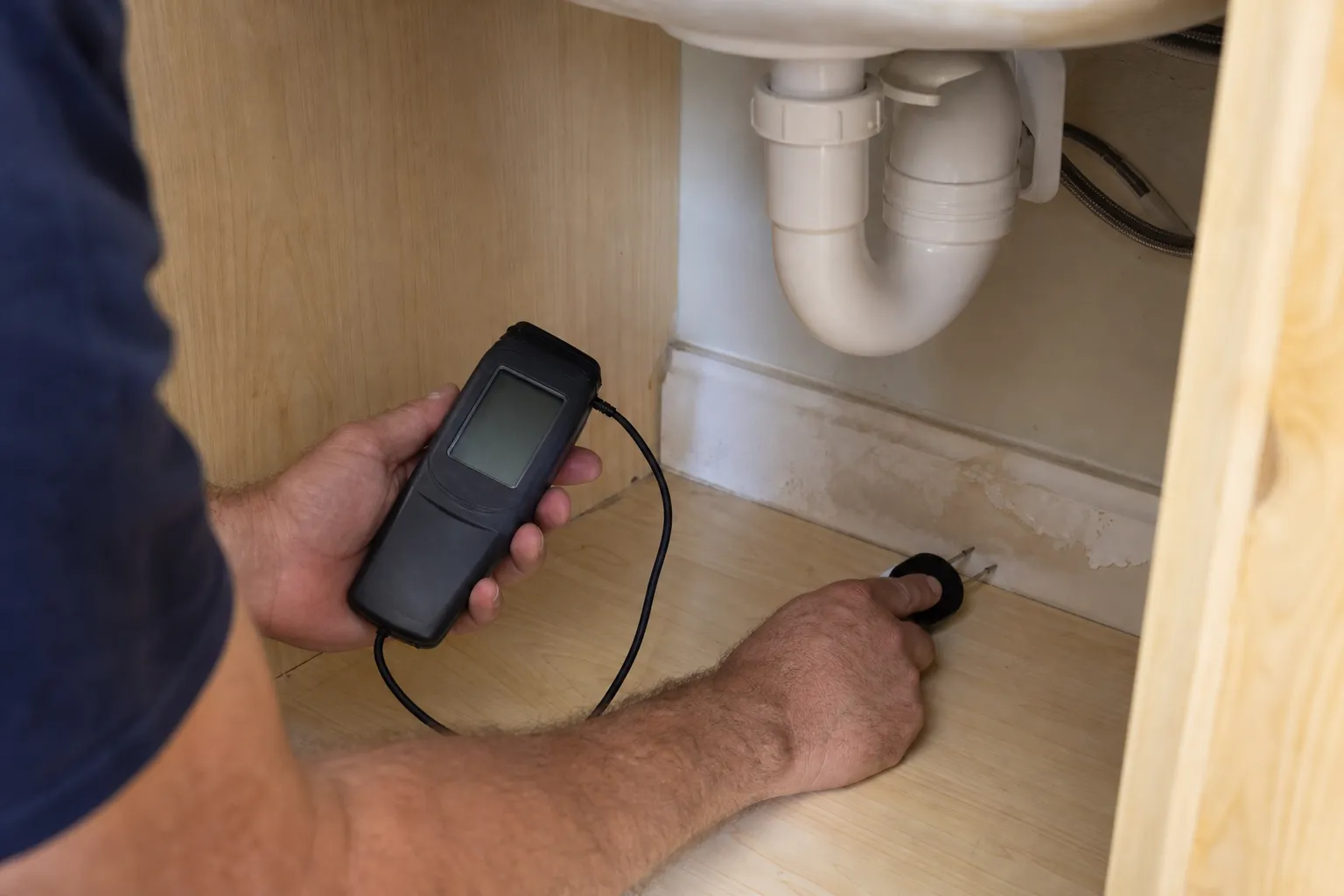
Beyond the flood test, a plumber may use a moisture meter against nearby walls, flooring, and ceiling surfaces to map how far the water has actually traveled. This step matters because the leak source and the furthest extent of the damage are not always the same location.
A thermal or moisture-mapping approach can sometimes reveal that water has traveled several feet from the actual pan failure point, following gaps in subfloor framing or settling into lower areas. A broader plumbing inspection at this stage also catches anything else nearby worth flagging before walls get opened.
Why guessing costs more than testing
Opening up tile without testing first often means removing far more than necessary, since there is no way to know in advance exactly where the failure sits or how far the water has spread. A flood test and moisture mapping cost relatively little compared to unnecessary demolition.
A few reasons testing first consistently saves money:
- It confirms whether the problem is surface-level grout or a true pan failure.
- It maps how far water has actually traveled before any tile comes out.
- It avoids opening walls or floors that turn out to be unaffected.
Skipping this step to save time upfront almost always costs more by the time the repair is finished.
Repair or replace: what actually makes sense
Not every shower pan leak requires tearing the whole shower out. The right fix depends heavily on what testing reveals, and on how far the damage has already spread.
Here is how that decision typically gets made.
When a pan can be saved
If the flood test confirms the pan membrane is intact and the issue is localized to the drain connection or a small section of seam, a focused repair is often possible without removing the entire shower. This usually means accessing the drain fitting from below, if the plumbing is accessible from a basement or crawlspace, or carefully cutting into the tile in a limited area.
A pan is generally a good repair candidate when:
- The flood test shows minimal or no water loss.
- Moisture mapping shows the damage limited to a small, specific area.
- The shower itself is relatively new and otherwise in good condition.
A repair under these conditions is faster and considerably less expensive than a full replacement.
When the whole shower has to come out
Once subfloor rot, extensive mold, or a membrane that has failed across a large section are confirmed, a full shower teardown is usually the honest recommendation rather than a patch that will fail again soon. Attempting a partial repair on a pan that has failed broadly tends to just relocate the problem rather than solve it.
A full replacement becomes the clear choice when:
- 1Subfloor rot extends beyond a small, isolated section.
- 2Mold has spread into framing or adjacent wall cavities.
- 3The pan itself is old enough that the membrane has likely degraded throughout, not just at one point.
This is a bigger project, but it is the only way to be confident the new shower repair will not develop the same hidden problem again in a year or two.
What a proper fix actually includes
A proper shower pan replacement includes removing the old pan and affected subfloor material, allowing everything underneath to fully dry, addressing any mold found during demolition, and installing a new waterproof membrane before tile goes back down. Skipping the drying step, in particular, is one of the most common corners cut in a rushed repair.
A hidden water line leak elsewhere in the same bathroom sometimes gets addressed in the same project rather than opening the same wall twice. Older homes around the Central Coast tend to share similar original waterproofing methods, from coastal cottages in Morro Bay to inland ranch houses further from the water. That shared history is part of why pan failures often show up around the same age range regardless of where the home sits.
Conclusion
A leaking shower pan is one of the more deceptive plumbing problems a home can have, precisely because the tile on top can look completely fine while real damage builds underneath. Catching it early, through the small signs rather than waiting for a ceiling stain, is what keeps a repair manageable instead of a full teardown.
Testing before demolition is what separates a focused, honest repair from unnecessary, expensive guesswork. A flood test and a little patience almost always pay for themselves.
If your shower has been giving you any of these quiet warning signs, reach out to Drain Doctors Plumbing and get an actual answer before the damage spreads any further.
Tell us what's going on and our licensed team will point you in the right direction. Call (805) 467-1214 or request service online.