
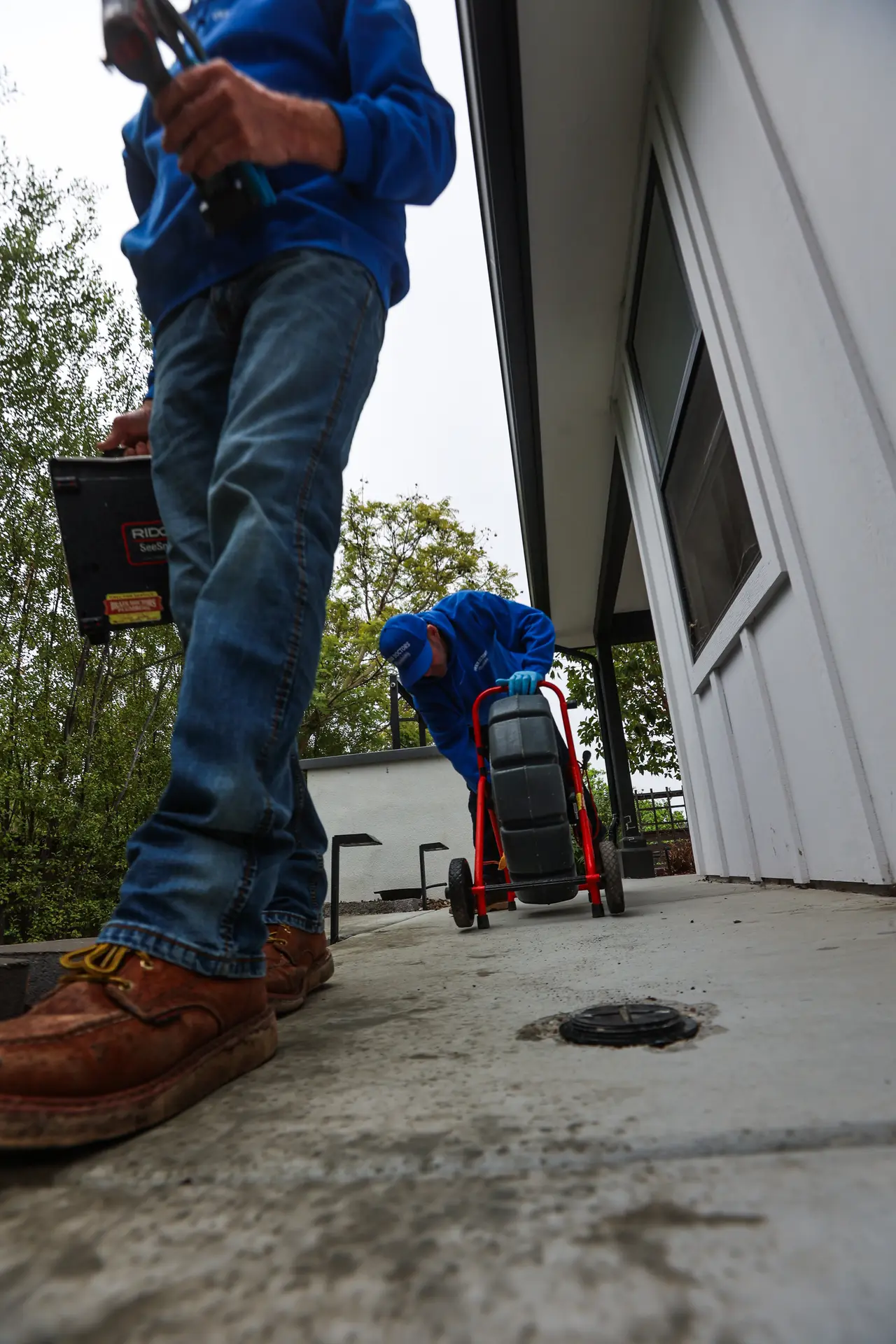
Every homeowner who calls about a sewer camera inspection asks the same first question: what does this cost? It's a fair question, and it's also one that doesn't have a single clean answer, because the price of a sewer camera inspection in San Luis Obispo County depends on a handful of variables that change from one property to the next.
Two homes on the same street can quote differently for the exact same service. One has an accessible cleanout in the front yard and a straight run of newer pipe. The other has no visible cleanout at all, a pipe that jogs around a mature oak root system, and a line that hasn't been touched since the house was built. The camera work is the same. Everything around it isn't.
This article breaks down the factors that actually move the number, why a phone quote rarely matches what shows up on the invoice, and how to get an accurate estimate before a technician ever shows up. The goal isn't to hand you a fixed figure. It's to help you understand what you're actually paying for.
A sewer camera inspection is one of the few plumbing services where the diagnostic step and the useful answer arrive at the same time, which is part of why the value tends to outweigh the cost once homeowners understand what's driving it.
In this article, you will learn about:
- Why there's no single number for this job
- The property factors that move the price
- When a camera inspection is cheaper than the alternative
- Getting an accurate quote instead of guessing
Keep reading to find out exactly what shapes the price of your inspection before you ever pick up the phone.
Why there's no single number for this job
Ask five plumbing companies what a sewer camera inspection costs and you'll likely get five different answers, and not because anyone is trying to mislead you. The service genuinely varies based on the property, the access, and what the job actually requires once a technician is standing in your yard.
That variability isn't unique to plumbing. It shows up in almost any diagnostic trade service where the scope depends on conditions a company can't see until they're on site. A roofer can't quote a repair without seeing the roof. A plumber can't quote a camera inspection without knowing how the pipe is laid out.
The honest answer is that pricing depends on factors like line length, access difficulty, and whether the job is a standalone inspection or bundled with another service call. Understanding those factors up front makes the eventual quote make sense instead of feeling arbitrary.
What a basic inspection actually includes
A standard sewer camera inspection covers feeding a waterproof camera through an access point, running it the length of the lateral, and reviewing the footage for defects. That base service typically includes a written summary of what the camera found, and in most cases the footage itself or key still images.
- Locating and, if needed, clearing the access point before the camera goes in.
- The camera run itself, tracked against a distance counter so any defect gets a location, not just a description.
- A review of the footage against known defect categories, followed by a written summary a homeowner can actually use.
What isn't included in that base scope is any repair work the footage points toward. That's a separate conversation and a separate quote, which is one reason a phone estimate for "camera inspection" alone rarely covers the full picture of what a property might need.
Why cash quotes over the phone rarely hold up
A dispatcher taking a call can give a reasonable starting range based on typical jobs in the area, but they can't see the property. They don't know if there's a cleanout, how far the pipe runs, or whether a previous owner poured a patio over the access point sometime in the last thirty years.
That's why a phone estimate is a starting point, not a final number. The actual price firms up once a technician has eyes on the property, and in most cases that happens the same day the work is scheduled, not as a separate paid visit.
Homeowners who've been burned by a low phone quote that ballooned once the crew arrived sometimes assume that's standard practice everywhere. It isn't, but it does mean asking what could change the number is a fair question to ask before booking, not after.
How location inside the county shifts the job
Older neighborhoods in cities like San Luis Obispo and Atascadero tend to have longer-established landscaping and tree cover, which means more root intrusion and more buried access points than in newer developments.
Newer subdivisions in places like Orcutt generally have shorter, straighter lateral runs with code-required cleanouts already in place, which usually makes for a faster, more predictable inspection.
Neither situation is better or worse, but they genuinely cost different amounts of technician time, and that time is most of what drives the number on the final invoice.
The property factors that move the price
Once you strip away the marketing language, most of what changes a sewer camera inspection quote comes down to three things: how far the camera has to travel, what condition the pipe is in, and how hard it is to get the camera into the line in the first place.
Each of these factors compounds. A long run with poor access and old, deteriorating pipe takes meaningfully longer than a short run with a clear cleanout and newer PVC, and that time difference is what shows up in the price, not an arbitrary markup.
Knowing which of these apply to your property before you call gives you a much better sense of where your quote is likely to land, and it helps you ask better questions of whoever's giving you the estimate.
Pipe length, access, and how far the camera has to travel
Longer laterals simply take longer to run a camera through, and properties set back from the street, or with a septic-to-sewer conversion that added distance to the line, tend to fall on the higher end of the time range. A short run under a small front yard is a very different job than a line running the length of a deep rural lot.
Access matters just as much as distance. A clear, code-compliant cleanout lets a technician get the camera into the line in minutes. A missing or buried access point means locating it, sometimes digging for it, before the actual inspection can even begin.
- Distance from the house to the street connection or septic tank.
- Whether the access point is a standard cleanout, a roof vent, or something less conventional.
- Obstructions along the route, like a driveway, a mature tree, or a hardscaped patio sitting over the line.
None of these are deal-breakers. They're just variables that change how long the job takes, and time is the primary driver of cost on a service like this.
Old pipe, new pipe, and why material matters
Older clay or cast iron pipe tends to have more defects to document than newer PVC, which means more time spent recording distance markers and describing findings in the report. A line riddled with root intrusion and offset joints simply generates more footage worth reviewing carefully than a clean, newer run.
That doesn't mean older pipe automatically costs more to inspect. It means the inspection is more likely to turn up findings that lead to a follow-up conversation about pipe repair or repiping, which is a separate cost from the camera work itself but one worth planning for if your home predates modern plumbing codes.
Homes in older sections of the county, where clay and cast iron laterals are still common, are more likely to see this play out than newer construction with PVC throughout.
What a missing or buried cleanout adds to the job
A cleanout is the standard access point for camera equipment, and its absence is one of the most common reasons a quote runs higher than a homeowner expected. Locating an alternative access point, or installing a new cleanout during the same visit, adds real time to the job.
- Searching for an existing but hidden cleanout under landscaping, gravel, or old paving.
- Running the camera through an alternate access point, like a roof stack, which is slower and offers a less complete view of the line.
- Installing a new, code-compliant cleanout as part of the visit, paired with drain cleaning or the inspection itself, so future visits go faster.
If you're not sure whether your property has an accessible cleanout, that's worth mentioning when you call. It's one of the single biggest factors in how smoothly, and how quickly, the inspection actually goes.
When a camera inspection is cheaper than the alternative
It's easy to look at a camera inspection as an added expense on top of an already long list of homeownership costs. The more useful way to think about it is against what it prevents, since the alternative to catching a problem early is almost always more expensive than the inspection itself.
California's own sewer overflow data backs this up in a general sense. When a sewer system report from the City of Pacifica documented a recent reporting period, more than 99 percent of the sewage volume that spilled during that period reached state waters rather than being contained, the kind of outcome that triggers regulatory attention and cleanup costs far beyond a routine inspection.
That's a city-level statistic, not a prediction for any individual property, but it illustrates the gap between a small, contained problem caught on camera and a full overflow that reaches the surface. The inspection is cheap by comparison, almost every time.
Catching root intrusion before it becomes a backup
Root intrusion rarely announces itself with a dramatic failure. It starts small, a few roots working into a hairline crack, and grows gradually until the line is restricted enough to cause slow drains or a full backup. By the time a homeowner notices symptoms, the roots have usually had months or years to establish themselves.
The progression tends to follow a fairly predictable pattern, even if the timeline varies from one property to the next:
- A small root mass narrows the flow path, causing gradual slowdowns that are easy to dismiss as normal aging.
- Debris starts catching on the roots, turning a minor restriction into a partial blockage.
- The blockage worsens until a backup shows up, usually at the lowest drain in the house first.
A camera inspection catches that intrusion at the small-problem stage, when a targeted cut-and-clear or a spot repair handles it. Waiting until the symptoms show up in the house means dealing with the mess, the cleanup, and often a more extensive repair, on top of whatever the inspection would have cost in the first place.
That timing difference is where the real savings show up. It's rarely about the inspection being cheap in isolation. It's about the inspection being cheap relative to what it prevents.
Buying and selling a home without a paperwork fight
A camera inspection ahead of a real estate transaction gives a seller documented proof of the lateral's condition, which heads off a negotiation that can otherwise eat far more money and time than the inspection itself. A buyer's agent who requests lateral footage mid-escrow, and gets a defect nobody expected, can turn a smooth closing into a drawn-out credit negotiation.
Sellers in markets like Nipomo and Arroyo Grande who get ahead of this, rather than waiting for a buyer to raise it, generally keep more control over both the timeline and the outcome.
The cost of the inspection is small next to the cost of a stalled escrow or a last-minute price reduction over a defect that could have been identified, and possibly resolved, weeks earlier.
Routine checkups versus emergency calls
A routine inspection scheduled on a normal weekday, with the homeowner able to plan around it, is almost always more affordable than an emergency call after a backup has already happened. Emergency work comes with urgency, potential water damage cleanup, and a repair scope that has to be figured out on the spot rather than planned in advance.
Homeowners with older homes, or properties they haven't had inspected in five or more years, tend to get the most value out of treating a camera inspection as routine maintenance rather than something you only call for once there's already a problem.
That shift in mindset, from reactive to routine, is where most of the long-term cost savings actually live.
Getting an accurate quote instead of guessing
The fastest way to a number you can actually trust is giving the office enough information to estimate accurately, rather than accepting a generic range and hoping it holds. A few details up front go a long way toward an honest, workable quote.
Beyond the phone call, the single most reliable way to get an accurate price is a same-visit estimate, where a technician looks at the property before committing to a number. That approach removes the guesswork on both sides.
The last piece worth understanding is what happens if the inspection turns up more than expected, since that's the moment a lot of homeowners feel blindsided if they weren't prepared for the possibility going in.
What to tell the office when you call
Mentioning whether you know the location of your cleanout, roughly how far your house sits from the street, and whether this is a routine checkup or tied to a specific symptom, like a slow drain or a real estate transaction, helps the office give you a more accurate starting range instead of a generic one.
It also helps to mention the age of the home and whether you know what the pipe material is, if that information is available. A few details in particular make the biggest difference in how accurate the initial range turns out to be:
- Whether you already know where the cleanout is, or if you've never located one.
- The approximate year the home was built, or when the plumbing was last updated.
- Whether you're calling because of a symptom, like slow drains, or as routine preventative maintenance.
A 1960s home with clay pipe and a 2015 home with PVC are different jobs before a technician ever sets foot on the property. None of this guarantees an exact number over the phone, since some factors genuinely can't be assessed remotely, but it narrows the range considerably and reduces the odds of a surprise once work begins.
Why a video walkthrough beats a verbal estimate
Once the inspection is complete, the footage itself becomes the best tool for understanding any follow-up quote. A technician who can point to a specific timestamp and say "this is the offset joint we're talking about" gives a homeowner something concrete to evaluate, rather than a verbal description that's hard to picture.
That's part of why a documented sewer line repair or replacement quote, tied to actual footage, tends to hold up better than an estimate based on symptoms alone. The camera doesn't guess. It shows exactly what's there.
Homeowners who ask to see the footage, rather than just reading the summary, generally end up with a clearer understanding of what they're paying for and why.
What happens if the inspection turns up more than expected
Occasionally a camera inspection reveals a bigger issue than the symptoms suggested, a fully collapsed section, or a length of pipe deteriorated well beyond a spot repair. When that happens, the inspection itself is complete and billed as quoted. The additional repair work gets its own separate estimate.
That separation matters. It means the inspection price you agreed to doesn't balloon just because the footage turned up bad news. What changes is the conversation that follows, about repair options, timeline, and scope, all of which get quoted on their own terms once the footage makes the problem clear.
Homeowners sometimes worry that a bad finding means an automatically expensive fix. In practice, plenty of camera findings resolve with a targeted, contained repair rather than the full-line replacement people picture. The footage is what determines that, not assumptions made before anyone's looked.
Conclusion
There's no single price tag that applies to every sewer camera inspection in San Luis Obispo County, and that's not a dodge, it's just how a diagnostic service tied to buried infrastructure actually works. Line length, access, pipe condition, and property age all play a role, and no two homes line up the same way on all four.
What matters more than chasing an exact number in advance is understanding what drives the quote you eventually get, and recognizing that the inspection itself is almost always the cheaper half of the equation compared to what it can catch before it turns into a bigger problem. A clear cleanout and a straightforward run keep things simple. A buried access point or decades-old clay pipe add time, and time is what you're really paying for.
If you want an accurate number instead of a guess, the fastest path is a real conversation about your specific property. Drain Doctors Plumbing can walk you through what to expect before a technician ever shows up, so you know what you're paying for and why.