
Hydro jetting uses a stream of high pressure water, often several thousand pounds per square inch, to blast years of grease, sludge, and root growth off the inside walls of a pipe rather than just punching a hole through the middle of a clog. If you have already tried a plunger, a store bought drain cleaner, and maybe even a standard cable snake, and the same drain in your San Luis Obispo or Santa Maria home keeps backing up a few weeks later, hydro jetting is usually the reason why the problem finally stops coming back.
Most homeowners only hear the term after a plumber has already been out once or twice for the same clog. That repeat visit is the tell. A snake breaks a path through whatever is blocking the line, water flows again, and everyone assumes the job is done. Then the grease coating or the root mass that never actually left the pipe regrows across that same path, and the clog returns right on schedule.
This article breaks down what hydro jetting actually is, how the equipment works, when it makes sense over other methods, and what a typical drain cleaning visit involves for a Central Coast home or business.
In this article, you will learn about:
- What hydro jetting is and how the equipment works
- When hydro jetting is the right call (and when it isn't)
- What actually happens during a hydro jetting visit
- Caring for your pipes after a jetting service
Keep reading to find out whether your recurring clog is a jetting problem, and what to expect if it is.
What hydro jetting actually is
Hydro jetting is a professional drain cleaning method that pushes water through a specialized nozzle at pressures that can reach several thousand pounds per square inch. That nozzle sprays water forward to break up the blockage and backward at an angle, which pulls the hose deeper into the line while scouring the pipe wall clean in the process.
The technology itself is not new. Municipal water agencies have used high pressure water jetting to maintain sewer mains for decades, and the same principle scaled down for residential lines works the same way. What's different for a home or small business is the size of the jetter, the diameter of hose used, and the amount of prep work a technician does before the water ever turns on.
It helps to picture what is actually happening inside a pipe that has not been jetted in years. Grease from years of dishwashing settles along the pipe wall and hardens. Fine root hairs work their way through hairline cracks in old clay or cast iron pipe and expand once they find moisture and nutrients inside. A cable snake chews a channel through the middle of that buildup, but the coating and the root mass are largely still there, clinging to the walls.
- Grease and soap buildup along the inside of kitchen and bathroom lines
- Root intrusion through joints, cracks, and old pipe seams
- Mineral scale in older galvanized or clay pipe
- Sludge and sediment that settles in low spots or bellied sections of line
- Sand or silt intrusion in lines with a compromised joint
Jetting removes all of that, not just a channel through the center. That is the core difference between jetting and snaking, and it's why a jetted line typically goes longer before the same symptoms return.
Snaking versus jetting, and why they solve different problems
Snaking and jetting are not competing versions of the same service. They solve different problems, and a good technician recommends one, the other, or both depending on what a camera inspection actually shows inside the line.
A cable snake is the right tool for a fresh, localized blockage, like a single clog of hair and soap in a bathroom sink trap or a toy that made it into a toilet line. It is fast, inexpensive, and does not require the same setup as a jetter. For that kind of isolated obstruction, snaking clears the path and the job is done.
Jetting earns its place when the problem is not one blockage but a buildup that spans a long stretch of pipe, or when the same drain keeps clogging every few months despite repeated snaking. Root intrusion, years of grease accumulation, and sediment in a main sewer line all fall into this category, and snaking alone tends to offer only temporary relief against them.
- 1Camera inspection identifies whether the issue is a localized clog or buildup along the pipe wall
- 2A single, isolated blockage typically calls for snaking first
- 3A recurring clog, root intrusion, or grease coating typically calls for jetting
- 4Some lines benefit from jetting followed by a follow up camera pass to confirm the wall is clean
Why root intrusion is such a common reason for jetting in this area
The Central Coast has a lot of homes built decades ago, and older clay and cast iron sewer lines are common across San Luis Obispo, Santa Maria, and the surrounding communities. Those pipe materials develop hairline cracks and loose joints over time, and tree roots are relentless about finding them.
A root does not need a large opening to get inside a pipe. Roots grow toward moisture and nutrients, and a joint that has separated by even a fraction of an inch is enough of an invitation. Once inside, a root has access to warm, nutrient rich wastewater every single day, and it grows accordingly, often filling a significant length of pipe with a dense root mass over a few years.
Every sewer system in the country deals with this to some degree. The Environmental Protection Agency estimates that sanitary sewer systems nationwide experience between 23,000 and 75,000 overflow events a year, and blockages and line breaks are named among the leading causes. Root intrusion is one of the most common contributors to those blockages, right alongside grease.
California data backs this up at the state level. The State Water Resources Control Board has found that operational causes, mainly grease, roots, and debris, account for roughly 82 percent of sewer overflows statewide, and utilities that adopted structured maintenance programs cut grease related overflows by about half.
- Clay pipe joints from older construction that have shifted or separated over time
- Cast iron lines nearing the end of their expected service life
- Mature trees planted close to the sewer lateral, a common layout in older SLO and Santa Maria neighborhoods
- Shallow lines where root systems have easy access to the pipe
Jetting is one of the few methods that can clear a root mass from the inside of a pipe wall rather than just punching through the center of it. That said, jetting is not a permanent fix for a pipe with a structural break or a severely offset joint. Those often show up as a wet spot in the yard with no obvious cause, and an honest technician flags that pattern before recommending leak detection, repair, or a small excavation instead of jetting a pipe that needs to be fixed.
Commercial kitchens face a version of this problem year round
Restaurants, cafes, and other commercial kitchens deal with grease buildup on a much faster timeline than a typical home. Every rinse of a pan or a fryer basket sends a small amount of fat and oil down the drain, and it does not take long for that to add up inside a grease trap and the line beyond it.
A residential jetting schedule of once every year or two does not translate to a commercial kitchen. These lines often need jetting on a quarterly or even monthly basis depending on volume, and skipping that maintenance is usually what leads to a backed up floor drain in the middle of a dinner rush rather than during a planned closure.
- Grease traps that fill faster than expected based on kitchen volume
- Floor drains near dish pits and prep sinks that see constant grease exposure
- Lines shared by multiple kitchen fixtures that compound buildup faster than a single line would
- Municipal grease ordinances that may require documented maintenance for commercial accounts
When hydro jetting is the right call, and when it isn't
Hydro jetting is a powerful tool, but it is not the correct answer for every clog, and using it on the wrong pipe can make a bad situation worse. Knowing which situation you are actually in matters more than knowing the name of the service.
The clearest sign that jetting is worth considering is a drain that keeps clogging on a predictable schedule despite having been snaked before. If a kitchen line, a floor drain, or a main sewer line backs up every two or three months and a snake keeps "fixing" it temporarily, that pattern points to buildup along the pipe wall rather than a single blockage, and buildup is exactly what jetting is built to remove.
Multiple slow drains happening at once is another strong signal. When more than one fixture in a home is draining sluggishly at the same time, especially fixtures on the lowest level of the house, the problem is often downstream in the main line rather than isolated to one fixture, and that is a jetting conversation, not a single drain snaking job.
- A drain that clogs again within a few weeks or months of being snaked
- Multiple slow drains happening at the same time, especially on the lowest floor
- Gurgling sounds coming from drains or toilets when other fixtures run
- Sewage odor near a floor drain, cleanout, or yard area
- A commercial kitchen or restaurant line with heavy, repeated grease buildup
Not every pipe is a good candidate, though. A camera inspection should always come before jetting on a line with unknown condition, because pipe that is already cracked, severely corroded, or made of certain older materials can be damaged rather than helped by high pressure water. This is exactly why an experienced technician looks at the pipe first and picks the right tool for the job rather than defaulting to the biggest tool available.
What a camera inspection tells a technician before jetting begins
A sewer camera inspection is a small waterproof camera fed through the line to show the technician exactly what condition the pipe is in before any water pressure gets involved. This step is not an upsell, it is the difference between jetting a line safely and jetting a line that was never a good candidate in the first place.
The camera reveals the pipe material, the location and severity of any cracks or offset joints, how far root intrusion extends, and whether there are low spots, or bellies, where debris tends to collect. That information determines the nozzle type, the water pressure, and how the job gets approached.
- 1Camera confirms pipe material and general condition
- 2Technician identifies the specific location and extent of blockage or root intrusion
- 3Jetting pressure and nozzle type get selected based on what the pipe can safely handle
- 4A follow up camera pass, when needed, confirms the wall is actually clean afterward
The honest answer on cost and what affects it
Every home's plumbing is different, and the honest answer to "how much does hydro jetting cost" is that it depends on the length of the line, how severe the blockage is, how accessible the cleanout is, and whether a camera inspection is needed first. Anyone who quotes a fixed number without seeing the situation is guessing.
Pipe age plays a real role in that equation. The American Society of Civil Engineers has reported that collection system failures nationwide climbed from 2 to 3.3 per 100 miles of pipe over the last decade, a trend tied directly to aging infrastructure and underscoring why older neighborhoods tend to see more root intrusion and joint separation than newer construction.
What does affect the price in a predictable way is the scope of the job. A single bathroom line with moderate grease buildup is a much smaller job than a main sewer lateral choked with root intrusion across a long run of pipe. Commercial kitchen lines with years of accumulated grease also tend to take longer than a typical residential job.
- Length and diameter of the pipe being jetted
- Severity and type of blockage, whether grease, roots, or sediment
- Ease of access to a cleanout versus needing to pull a toilet or access through a roof vent
- Whether a camera inspection is needed before or after the jetting itself
Signs a quote is worth being cautious about
A quote that comes in dramatically lower than everyone else's, or one that gets given over the phone with no camera inspection and no questions about the line's history, is worth a second look. Jetting is not a commodity service where the cheapest bid is automatically the safest choice.
The bigger red flag is a company that pressures a same day upsell to a full pipe replacement before ever running a camera through the line. A legitimate diagnosis comes from actually seeing the condition of the pipe, not from a guess based on the age of the house or how long the drain has been slow.
- 1Get a camera inspection before agreeing to any repair or replacement recommendation
- 2Ask what the quote is based on and whether it changes once the line is actually seen
- 3Be cautious of a quote given without ever visiting the property
- 4Expect a written explanation of what the camera found, not just a verbal estimate
What actually happens during a hydro jetting visit
Knowing the general shape of a jetting appointment makes the whole process less of a mystery, and it helps you ask better questions when a technician is standing in your driveway explaining what they are about to do.
Most visits follow a fairly consistent sequence, though the specifics shift depending on what the camera inspection turns up. A technician who skips straight to jetting without looking at the pipe first, or who cannot explain what they found, is a technician worth being cautious about.
- 1Initial camera inspection to confirm pipe condition, material, and the exact location of the blockage
- 2Locating the nearest cleanout, or determining the best access point if no cleanout exists
- 3Selecting the jetter, hose length, and nozzle type appropriate for that specific pipe
- 4Running the jetting hose through the line, working from the access point toward the blockage
- 5A follow up camera pass to confirm the pipe wall is actually clear, not just passable
Access matters more than people expect. A home with a proper exterior cleanout makes the whole job faster and less invasive, while a home without one may require accessing the line through a roof vent or, in rare cases, pulling a toilet. Every truck on this team carries a jetter, so equipment availability is never the reason a job gets delayed or upsold into a return visit.
What you can expect to see and hear
A jetting appointment is louder and more involved looking than a standard snaking visit, mostly because of the jetter itself and the hose reel it runs from. That is normal, and it does not mean anything has gone wrong.
You may notice water and debris coming up through a cleanout or a nearby fixture at some point during the process, particularly if the blockage was severe. Experienced technicians manage this with tarps, containment, and careful hose control, but it's worth knowing ahead of time so it does not come as a surprise mid-appointment.
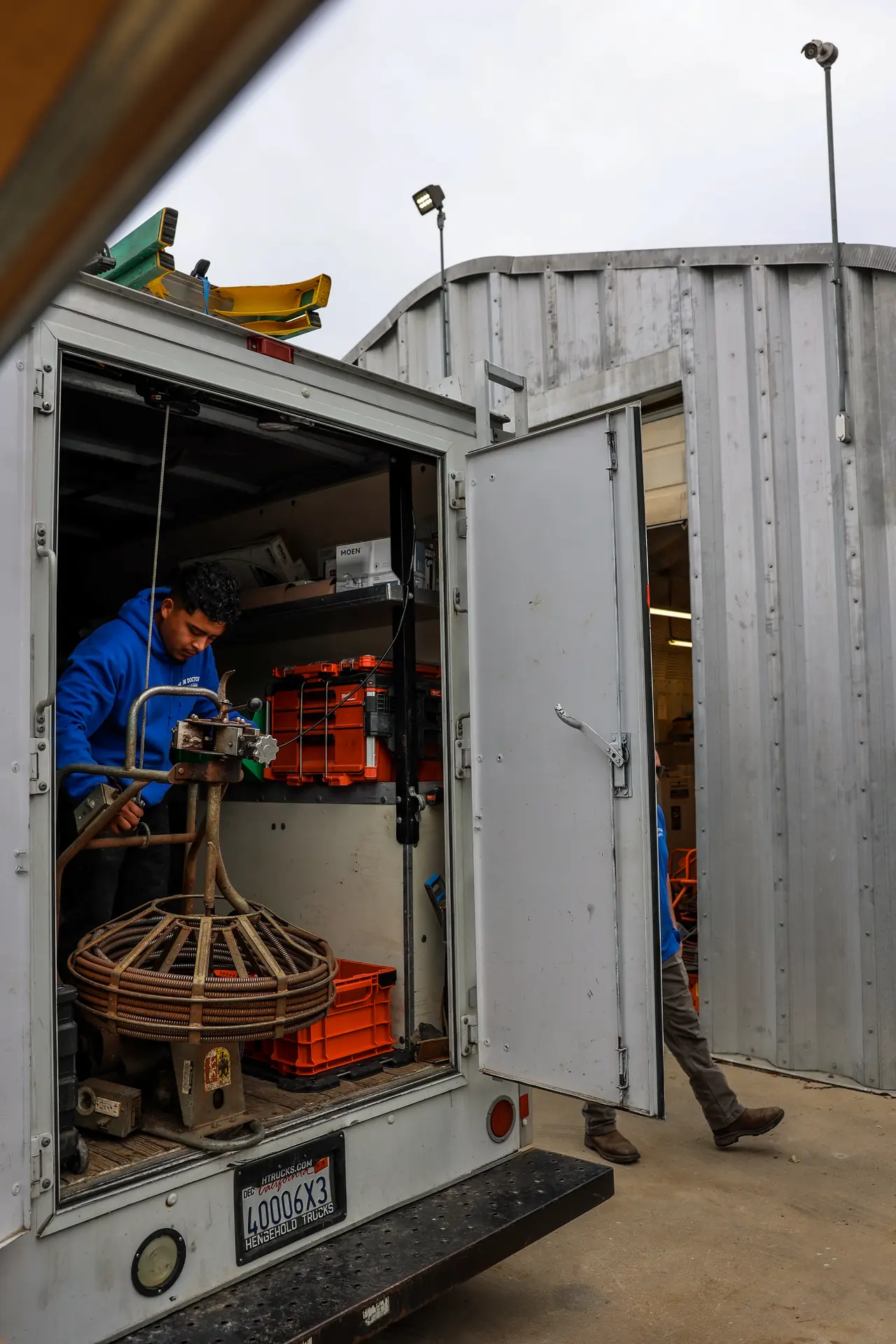
- The jetter itself, a machine about the size of a large generator, staged near the access point
- A long hose reel feeding into the cleanout or access point
- Some water and debris surfacing at the cleanout during active jetting
- A noticeably different sound from the water when the pipe wall goes from clogged to clear
Why the right tool from the start actually saves money
There's a version of this service where a company sends out the cheapest, smallest tool first, charges for that visit, and only reaches for jetting after two or three return trips have already failed to solve the underlying problem. That approach costs a homeowner more in total, not less, even though each individual visit looked cheaper on paper.
Starting with an accurate camera inspection and the right equipment for what that inspection reveals means fewer surprise return visits and a clearer sense of what the job actually requires before work begins. It also means a jetted line stays clear substantially longer than one that was only ever snaked, because the buildup causing the recurring problem is actually gone rather than just pushed aside.
How long a jetting appointment typically takes
A straightforward residential jetting job, like a single kitchen line or a bathroom group with moderate buildup, usually wraps up within an hour or two once the camera inspection and setup are done. Access and severity are the two biggest variables that stretch that timeline.
A main sewer line with significant root intrusion, or a commercial kitchen line that has not been serviced in a long time, takes longer because there is simply more material to clear and more of the pipe wall to scour clean. A follow up camera pass adds a bit more time but is worth it for the confirmation that the job actually worked.
- A single fixture line with light to moderate buildup: often under an hour
- A main sewer lateral with root intrusion: typically longer, depending on length and severity
- A commercial kitchen line with years of grease: usually the longest of the common scenarios
- Any job requiring non-standard access, like a roof vent, adds time to the setup
Caring for your pipes after a jetting service
A freshly jetted line is about as clean as a pipe gets without being replaced, and a little routine care afterward stretches that clean interval considerably longer. None of this is complicated, but it does require a bit of consistency.
Grease is the single biggest contributor to buildup in kitchen lines, and it is also the easiest to manage day to day. Pouring fat, oil, or grease down a drain, even in small amounts over time, rebuilds the exact coating that jetting just removed. Letting grease cool and go in the trash instead costs nothing and does more for a drain's long term health than almost anything else on this list.
- Avoid pouring grease, oil, or fat down any drain, even when it's still liquid
- Run hot water through kitchen and bathroom drains regularly to discourage buildup
- Use drain strainers to catch hair and food particles before they enter the pipe
- Schedule periodic drain maintenance rather than waiting for the next backup
- Address any known root intrusion risk, such as a large tree near the sewer lateral, proactively
Root intrusion tends to come back without a maintenance plan
Jetting clears roots that have already made it into a pipe, but it does not stop new root growth from reaching that same crack or joint again over time, particularly with mature trees near the lateral. A property with a known root intrusion history benefits from a periodic maintenance schedule rather than treating each jetting visit as a one time fix.
This is where an honest conversation with a technician pays off. A camera inspection can identify exactly which section of pipe has a compromised joint or crack that keeps inviting roots back in, which turns a recurring surprise into something you can plan around instead. In some cases, addressing the root cause means a targeted repair to that specific section rather than repeated jetting on a schedule.
- 1A first jetting service to fully clear existing buildup or root mass
- 2A camera confirmation of pipe condition and any structural weak points
- 3A recommended maintenance interval based on what that inspection shows
- 4A targeted repair conversation if a specific joint or crack keeps causing repeat root intrusion
When a second opinion or a repair conversation makes more sense than repeat jetting
If a line needs jetting on a short, repeating cycle even after camera confirmed the wall was clean, that pattern usually points to a structural issue rather than an ongoing maintenance need. A cracked pipe, a severely offset joint, or a bellied section holding standing water will keep inviting the same problems back no matter how thoroughly the line gets jetted.
An honest technician says so directly rather than quietly scheduling another jetting visit every few months. Sometimes the more cost effective path over a few years is a targeted repair or a small excavation on the specific section causing the recurring issue, and that conversation should happen once the pattern becomes clear rather than after years of repeat service calls.
What to ask before booking a jetting service
A short list of questions upfront saves a lot of guesswork later, and any technician confident in their process should be glad to answer them directly rather than getting vague.
Asking about the camera inspection process, the pressure and nozzle approach for your specific pipe material, and whether a follow up inspection is included gives a clear picture of what you are actually paying for. It also tends to reveal quickly whether a company is being thorough or just trying to get in and out.
- Will a camera inspection happen before jetting begins, and will I see the footage
- What pipe material is the line, and does that change the approach
- Is a follow up camera pass included to confirm the line is actually clear
- What would make this line a poor candidate for jetting in the first place
Conclusion
Hydro jetting solves a different problem than snaking does. Where a snake punches a path through a blockage, jetting scours the entire pipe wall clean, which is why it holds up so much better against grease buildup and root intrusion that keep coming back no matter how many times a line gets snaked.
Knowing the difference matters most the second or third time the same drain backs up. A recurring clog, gurgling fixtures, or a sewage smell near a cleanout are all signs worth having looked at with a camera before assuming another snaking visit will fix it for good.
If your San Luis Obispo or Santa Maria home keeps dealing with the same stubborn clog, Drain Doctors can run a camera inspection, explain exactly what's happening inside the line, and recommend the right tool for the job rather than the smallest one. Reach out to Drain Doctors to get it sorted out for good.