
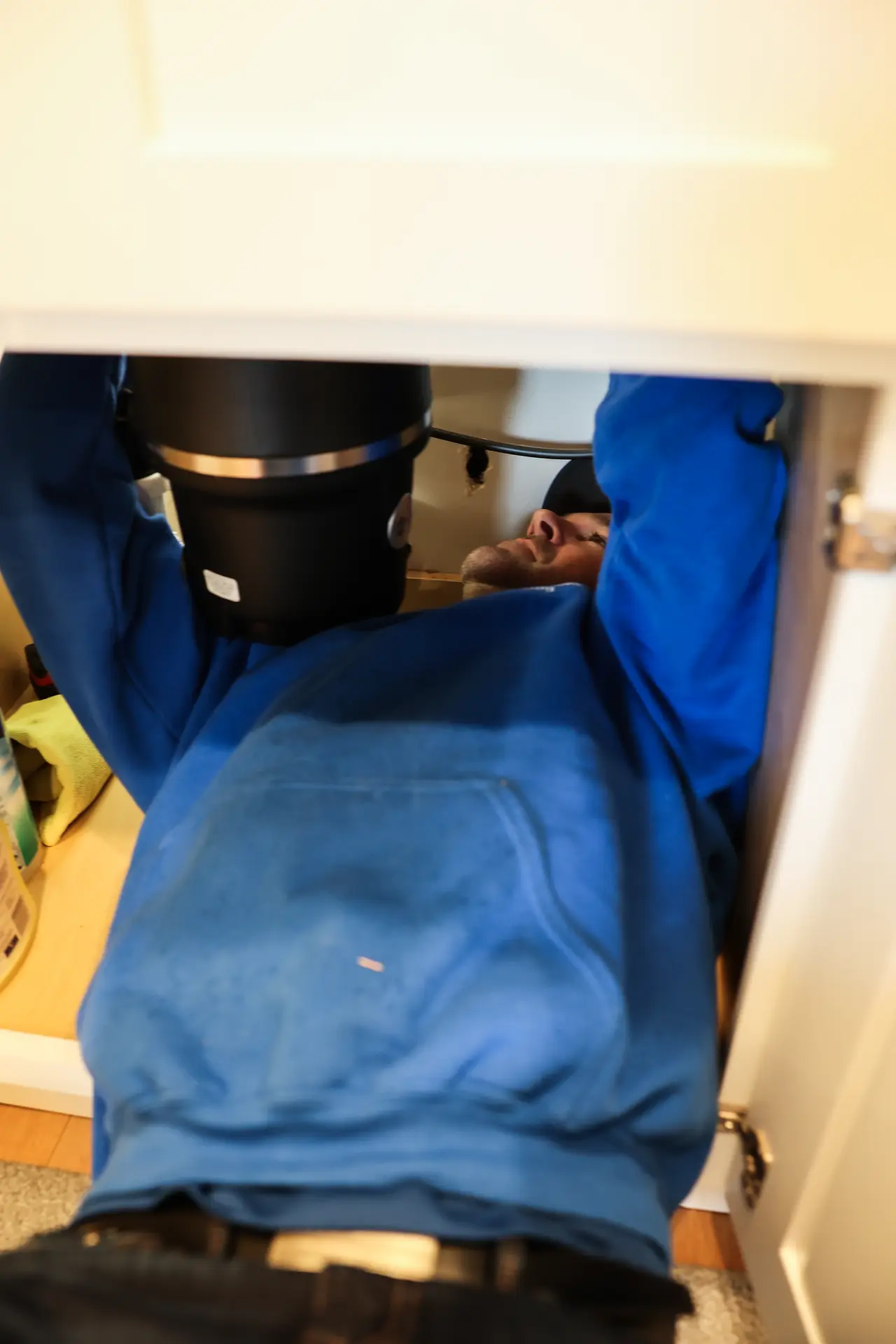
You flip the switch and instead of the usual grinding sound, you get a low, steady hum. No chopping, no water swirling away, just that same mechanical buzz until you finally give up and turn it off. It's one of the most common calls we hear from homeowners across San Luis Obispo, and the good news is that this specific symptom usually points to one clear cause rather than a mystery.
A humming disposal with no spin almost always means the motor still has power and is trying to run, but something is physically stopping the turntable, called the flywheel, from turning. That's very different from a disposal that's completely silent or dead, which usually points toward an electrical problem instead. The distinction matters, because the fix for a jam is almost nothing like the fix for a dead motor.
This guide walks through exactly why this happens, what you can safely check yourself before calling anyone, and when the situation has moved past a simple jam into something a professional needs to look at. Knowing the difference upfront saves you time, and sometimes saves you an unnecessary repair or replacement.
In this article, you will learn about:
- What actually causes the humming without spinning
- How to safely check and clear a jam yourself
- When humming means something more serious
- What a professional repair visit actually involves
Keep reading to find out whether this is a two-minute fix or a sign of something bigger going on underneath your sink.
What actually causes the humming without spinning
The sound itself is diagnostic. A disposal that hums steadily, without any grinding noise layered on top, is telling you the motor is receiving power and attempting to spin the flywheel, but something is blocking that rotation. Understanding what that blockage usually is takes most of the mystery out of the problem.
Almost every case of this symptom traces back to one of a small handful of causes, and they're rarely as serious as the sound makes them feel in the moment. The trick is figuring out which one you're dealing with before you decide what to do next.
- A physical object lodged against the impeller or wedged into the flywheel, by far the most common cause.
- A seized flywheel from corrosion or mineral buildup after extended disuse, even with nothing physically blocking it.
- An internal motor fault, worn bearings, a failing capacitor, or degraded windings, that limits torque without any mechanical obstruction at all.
Each of these has its own telltale signs and its own fix, and walking through them one at a time makes the difference easy to spot. The order below goes from most common and least serious to least common and most serious.
A physical object is almost always the culprit
The single most common cause is something solid lodged against the impeller or wedged into the flywheel itself. Fruit pits, bottle caps, bits of broken glass, and even a stray piece of silverware that slipped past the sink strainer are the usual suspects. The motor senses resistance the instant it tries to spin, and the safety mechanism inside keeps it from forcing through.
This is mechanically simple, even if it sounds alarming from the sink side. The object isn't damaging anything as long as the motor isn't forced to keep straining against it, which is exactly why cutting power quickly matters more than anything else in this situation.
Age and corrosion can seize the flywheel even without debris
If a disposal sits unused for an extended stretch, especially in a vacation home or a kitchen that doesn't see much cooking, the flywheel and impellers can seize up from corrosion or mineral buildup alone. No object needs to be present. The moving parts simply haven't turned in a while and have started to bind.
This is more common in older Central Coast homes with plumbing that's seen decades of hard, mineral-heavy water pass through it, the kind of buildup a water treatment system can slow down elsewhere in the house even if it won't touch the disposal directly.
A worn-out motor can hum without ever having a mechanical jam
Less commonly, the motor itself has developed an internal fault, worn bearings, a failing capacitor, or degraded windings, that prevents it from generating enough torque to turn the flywheel even with nothing physically blocking it. It's a similar aging pattern to what shows up in a water heater nearing the end of its service life, harder to diagnose from the outside since the early symptoms look the same as something minor.
The way to tell the difference is usually by process of elimination. If manually freeing the flywheel and confirming it spins smoothly by hand still doesn't restore normal operation once power is back on, the problem has likely moved from mechanical to electrical.
How to safely check and clear a jam yourself
Most humming-without-spinning calls turn out to be a straightforward jam, and a lot of them can be cleared without a service visit at all. The process is simple, but the safety step at the start is not optional.
Doing this in the wrong order, especially skipping the power cutoff, is the one real risk here. Everything else is low-stakes trial and error, and most homeowners can work through it in a few minutes with basic tools already in a kitchen drawer.
Cutting power comes before anything else touches the unit
The very first step, before any tool comes out, is cutting power to the disposal completely. That means the wall switch and then the breaker, or unplugging the unit entirely if it runs off an outlet under the sink rather than a hardwired switch.
Skipping this step is the one genuine safety risk in the whole process. A disposal that's still receiving power can activate unexpectedly if the switch gets bumped while your hands or a tool are inside the chamber, and that's the single outcome worth being careful about.
The Allen wrench trick clears most jams in under five minutes
Once power is confirmed off, the actual mechanical fix is straightforward. Locate the hex-shaped hole at the center of the bottom of the unit and insert an Allen wrench, which sometimes comes included with the disposal or is easy to find at any hardware store if you don't have one.
- 1Insert the Allen wrench into the hex hole and turn it firmly in both directions to manually rotate the flywheel.
- 2Continue working the wrench until the flywheel turns freely through a full rotation without resistance.
- 3Once it spins smoothly by hand, use tongs or pliers, never your fingers, to remove any visible debris, the same caution any plumbing repair around moving parts calls for.
- 4Press the small red reset button on the bottom of the unit, restore power, and run cold water while briefly testing the disposal.
If the flywheel spins freely by hand but the unit still hums instead of grinding once power is restored, that points away from a simple jam and toward something more serious with the motor. At that point, further attempts to force it are more likely to cause damage than fix anything.
A few things are worth avoiding no matter how tempting they seem
Even a simple jam invites some bad instincts, and a few of them can turn a five-minute fix into a real repair bill. Patience and the right tool matter more than speed here.
- Never reach into the disposal chamber with your hand, even with power confirmed off, since a jarred switch is a real risk.
- Never use household chemical drain cleaners to try to dissolve a suspected clog contributing to the jam, since hydro jetting is the safer professional option for anything beyond a surface-level blockage.
- Never keep flipping the switch repeatedly hoping it clears itself, since repeated attempts against a jam can burn out an otherwise healthy motor.
Working through these steps calmly, in order, resolves the overwhelming majority of humming disposal calls without ever needing a technician. When it doesn't, that's useful information in itself, since it points toward the causes covered next.
When humming means something more serious
Sometimes the flywheel test doesn't resolve anything, and that's the point where it stops being a do-it-yourself situation. A few specific signs tell you the problem has moved beyond a simple mechanical jam.
Knowing these signs ahead of time means you're not stuck guessing whether to keep troubleshooting or make a call. Some of them are subtle, and some are impossible to miss.
- The reset button trips again immediately, even after a confirmed manual reset of the flywheel.
- Any burning smell, however faint, coming from the unit while it's running.
- Standing water or a slow drain accompanying the humming, suggesting the real issue sits downstream.
Each of these calls for a slightly different response, and one of them, the burning smell, is urgent enough that it changes what you should do immediately rather than just who you should call.
The reset button keeps tripping no matter what you try
If pressing the reset button results in an immediate or near-immediate trip again, even after confirming the flywheel spins freely, that usually points to an internal electrical fault rather than a mechanical blockage. The motor is drawing too much current somewhere, and repeatedly resetting it does not fix the underlying cause.
This is one of the clearer signals that the issue has shifted from something you can clear with a wrench to something that needs a technician's attention, not unlike diagnosing a failing sump pump motor, since guessing at electrical faults from the outside of a sealed unit isn't realistic.
A burning smell changes the situation immediately
Any burning odor, even faint, coming from the disposal is a signal to stop everything and cut power at the breaker, not just the switch. This usually means the motor windings have already sustained damage, and continuing to run the unit risks a genuinely dangerous outcome rather than just a broken appliance.
Unlike a jam, this isn't something that resolves with patience or a few tries. It's a sign the unit needs a professional look, and possibly replacement, before it runs again.
Water backing up alongside the humming points to a separate problem
Occasionally the disposal hums for an unrelated reason: standing water in the sink is putting pressure on the system, or a downstream clog is affecting how the unit drains after each cycle. In these cases, the disposal itself might be fine, and the real issue is a drain cleaning that needs to happen first.
A kitchen sink backing up at the same time as a humming disposal is worth mentioning specifically when you call for service, since it changes where a technician starts looking.
What a professional repair visit actually involves
Once you've ruled out a simple jam, or decided the situation is beyond what you want to handle yourself, a service visit follows a predictable process. Knowing what to expect takes some of the uncertainty out of calling.
A technician isn't guessing any more than you would be. There's a clear sequence to how a disposal problem like this gets diagnosed and resolved.
Diagnosis starts with confirming what kind of problem it actually is
The first step is almost always confirming whether the issue is mechanical or electrical, since the whole repair path depends on that answer. A plumber will typically test the flywheel manually, check the reset button behavior, and in some cases test the motor's electrical draw directly to see whether it's pulling more current than it should.
This diagnostic step matters because guessing wrong here means either an unnecessary repair or a missed one. A technician who's confirmed the actual cause can tell you honestly whether you're looking at a five-minute fix or a garbage disposal repair that involves replacing internal components.
- Manual flywheel testing confirms whether the unit turns freely with power off.
- Reset button behavior after a manual test shows whether an electrical fault is present.
- Electrical draw testing, when needed, measures whether the motor is pulling more current than it should.
Running through these in order usually settles the question within the first few minutes of a visit, well before any tools come out to actually open the unit up.
A mechanical jam is usually resolved on the spot
If the cause is confirmed to be a physical blockage or a seized flywheel from disuse, the fix is typically quick. The technician clears the obstruction, manually works the flywheel free, tests the unit under running water, and walks through what likely caused it so you can avoid a repeat.
For households with an older unit, whether in Santa Maria or elsewhere in the county, or one that sits idle for long stretches, this is also a natural point to discuss whether periodic maintenance, or an upgrade to a newer unit, makes sense going forward.
An electrical or motor fault usually means replacement, not repair
When the humming traces back to a genuine motor fault, worn bearings, failed windings, or a persistently tripping reset circuit, replacement is typically the honest recommendation rather than an attempted repair. Disposal motors are sealed units, and there's no practical way to rebuild a failing motor the way you might repair an external part.
A straightforward swap is usually a same-day job, and it's also a chance to address any underlying issue that may have contributed, like sizing the replacement disposal appropriately if your household's usage has outgrown the original unit's capacity.
Manufacturers generally position disposals as a wear-driven appliance rather than something meant to last indefinitely, and the U.S. Environmental Protection Agency has reported that food waste made up more than 35 million tons of what went to landfills in a recent year, a volume that a working disposal helps a household avoid contributing to in the first place.
Conclusion
A garbage disposal that hums but won't spin is almost always telling you something specific: the motor has power, but something mechanical is stopping it from turning. Most of the time, that something is a simple, physical jam you can clear yourself with an Allen wrench and a few minutes of patience.
When the flywheel spins freely by hand but the humming continues, or when the reset button won't hold, or when there's any hint of a burning smell, the situation has moved past a do-it-yourself fix. At that point, a professional diagnosis tells you honestly whether you're looking at a quick repair or a unit that's reached the end of its useful life.
If your disposal is humming and you're not sure what's actually going on underneath it, the team at Drain Doctors Plumbing can take a look and give you a straightforward answer before it turns into a bigger problem.