
What a pressure regulator does, in plain terms, is take the pressure coming from the street and bring it down to a level your home's pipes, fixtures, and appliances can actually handle. Without one, whatever pressure the water utility pushes through the main line arrives at your faucets unchanged, and in a lot of San Luis Obispo County neighborhoods, that number runs a lot higher than most homeowners assume.
Most people never think about this small valve until something goes wrong. It sits quietly near where the main line enters the house, usually behind an access panel or tucked against an exterior wall, doing a job nobody notices when it's working right.
The problem shows up gradually. A hose bib that hisses louder than it used to, a water heater that fails years ahead of schedule, a toilet that won't stop running: these are often symptoms of pressure that's been running too high for months or years before anyone connects the dots.
This article breaks down how the valve works, why the Central Coast's terrain and older housing stock make pressure problems more common here than in flatter, newer markets, and what to expect if you have your home's pressure tested and adjusted. By the end, you'll know whether what you're dealing with is a quick fix or something bigger.
In this article, you will learn about:
- The simple mechanics behind a pressure regulator
- Why Central Coast plumbing runs into pressure trouble more than most
- Signs that quietly point to a failing regulator
- Getting a regulator tested, repaired, or replaced
Keep reading to find out whether your home's water pressure is quietly working against your pipes, your fixtures, and your water heater.
The simple mechanics behind a pressure regulator
A pressure regulator, sometimes called a pressure reducing valve or PRV, is a mechanical valve with a spring loaded diaphragm inside it. As pressure on the inlet side rises, the diaphragm pushes back and narrows the opening, which is what keeps the pressure on the house side steady no matter how much the street side pressure fluctuates.
It's a purely mechanical device. There's no electronics and nothing to program, which is part of why it can run for a decade or more without anyone thinking about it, and also why a failure can go unnoticed for just as long.
How the valve knocks pressure down to a safe range
Water pressure at the meter can vary a lot depending on the time of day, how much water your neighbors are using, and how far uphill the utility has to push it to reach your street. A regulator takes whatever number arrives, sometimes well over 100 psi in parts of the county, and steps it down to a consistent range on the house side.
Most regulators are adjustable, with a screw or bolt on top that a technician can turn to raise or lower the set point. Homeowners can technically do this too, but getting it wrong in either direction either starves fixtures of pressure or defeats the point of having a regulator in the first place.
What counts as normal water pressure in a home
Not every home runs at the same pressure, and that's normal. What matters is staying within a range your plumbing was actually designed for, rather than whatever the street happens to deliver on a given day.
California's plumbing code sets the outer limit at 80 psi, and most plumbers aim well below that ceiling in practice, since comfortable water pressure and safe water pressure aren't quite the same number.
- Below 40 psi typically feels weak at the shower and slow to fill a washing machine.
- 50 to 70 psi is the range most plumbers consider ideal for daily household use.
- 80 psi is the maximum California's plumbing code allows before a regulator becomes mandatory.
- Anything consistently above 80 psi puts steady strain on pipe joints, valves, and appliance connections.
If a plumber tests your home and finds a reading close to or above that 80 psi ceiling, that's not automatically an emergency, but it is a sign the regulator either isn't installed or isn't doing its job anymore.
The fix is rarely complicated. In most cases it's either adjusting an existing regulator that's drifted out of range or replacing one that's simply reached the end of its service life.
Where the regulator lives in your plumbing system
The regulator sits at a single, specific point: right where the main water line enters the house, almost always before it splits off to feed the water heater, the bathrooms, the kitchen, and every other fixture. Everything downstream of that point depends on it.
Because of that placement, a full plumbing inspection almost always includes a pressure check as one of the first steps, since a single failing valve can explain problems that otherwise look unrelated, from a noisy dishwasher to a slow leak under a sink.
Why Central Coast plumbing runs into pressure trouble more than most
San Luis Obispo County isn't flat, and that matters more than most homeowners realize. Water pressure is partly a function of elevation, and a county with this much variation between the coastline and the inland valleys is going to see bigger swings than a flat suburban grid ever would.
Add in a housing stock where plenty of homes predate the current plumbing code, and you get a market where pressure problems show up more often, and go unnoticed longer, than in newer developments built with modern regulators from day one.
Elevation changes across San Luis Obispo County
Pressure at the tap is tied directly to how far water has to travel, and how much elevation it has to climb or drop, to get there. A water district can deliver a perfectly consistent number at the treatment plant and still see very different readings by the time it reaches individual neighborhoods.
That variation is exactly why a regulator matters more in a county like this one than it would somewhere with flat terrain and a single water source. The patterns below reflect what our technicians see across the service area, not a guarantee for any individual address.
- Homes up in Paso Robles often see the highest static pressure in the county. Inland elevation changes push it well past 80 psi at the meter in some neighborhoods.
- Templeton sits close behind. Many of its older streets still run on service lines sized for a lower era of pressure.
- Coastal properties in Avila Beach can spike at certain hours. Pump stations there push water uphill to reach the hillside lots above the harbor.
- Morro Bay sees a similar pattern along the bluffs. Elevation can swing within a few blocks and change the reading at the tap.
- Neighborhoods within San Luis Obispo itself vary block to block. The city sits across several distinct pressure zones rather than one uniform number.
- Arroyo Grande and the surrounding foothills add another layer. Pressure tends to climb as the ground rises away from the creek.
- Santa Maria draws from more than one water district. Nipomo does too. So does Orcutt, which is one reason a reading on one street doesn't always match the next.
None of this means every home in a higher pressure area has a problem. It means the margin for error is smaller, and a regulator that's drifted out of adjustment or finally failed is going to cause noticeable trouble faster here than it would somewhere with naturally gentler pressure.
It's also why a pressure reading taken at one address isn't a reliable stand-in for the house next door, let alone a house across town. Testing your own plumbing is the only way to know where you actually stand.
Older homes with pipe that wasn't built for today's pressure
A lot of the housing stock across the county predates the current plumbing code, and that matters here specifically. Homes built before regulators were required may never have had one installed, even in areas where street pressure comfortably clears 80 psi.
Older galvanized supply lines are particularly vulnerable. Decades of mineral buildup narrow the interior of the pipe, and when unregulated pressure pushes against that narrowed, corroded metal, it's a combination that tends to end in a leak rather than a slow decline.
A home showing rust colored water, low flow at multiple fixtures, or pinhole leaks in more than one spot is dealing with pipe that has already started failing. High, unregulated pressure tends to speed up that failure rather than slow it down.
None of this means every older home needs a repipe. It means an aging system has less margin to absorb pressure that's running higher than it should, which makes catching a failing regulator early more valuable in an older home than a newer one.
A regulator that's simply worn out
Sometimes the terrain and the age of the home have nothing to do with it. Regulators are mechanical parts, and mechanical parts wear out. The diaphragm inside stiffens or cracks with age, mineral deposits build up around the seat, and the spring that controls the set point loses tension over years of constant use.
A worn regulator doesn't always fail all at once. More often it drifts, letting a little more pressure through each year until the difference finally becomes noticeable in the form of banging pipes or a leak that shows up out of nowhere.
Left unaddressed long enough, that drift can force fittings apart at the joints, and a full repipe sometimes becomes the more practical option once enough of the system has been stressed for enough years.
Most of the time it doesn't get that far. Catching a worn regulator during a routine inspection is a straightforward fix, and it's a lot less disruptive than dealing with the damage it eventually causes if it's ignored.
Signs that quietly point to a failing regulator
Most homeowners don't wake up one day and decide to test their water pressure. Something else usually tips them off first: a noise, a bill, a fixture that stops behaving the way it used to, and the pressure only enters the conversation once a plumber starts asking questions.
The signs tend to fall into two categories: things you notice happening inside the house day to day, and damage that's already quietly accumulating in the background. Both matter, but for different reasons: one warns you, the other bills you.
What you'll notice inside the house first
High pressure tends to announce itself through sound before anything else. Pipes that bang or shudder when a faucet shuts off quickly, a phenomenon plumbers call water hammer, are one of the more common early warnings that pressure is running higher than the system was built to handle.
Fixtures themselves start acting off too. A faucet that drips within months of being repaired, or a shower valve that chatters or sprays unevenly, is often reacting to pressure the fixture wasn't built to handle rather than a defect in the fixture itself.
- Pipes that bang, shudder, or produce a hammering sound right after a faucet or valve closes.
- Water that sprays harder than expected, sometimes hard enough to splash outside the sink or tub.
- Fixtures that need repair or replacement more often than they reasonably should.
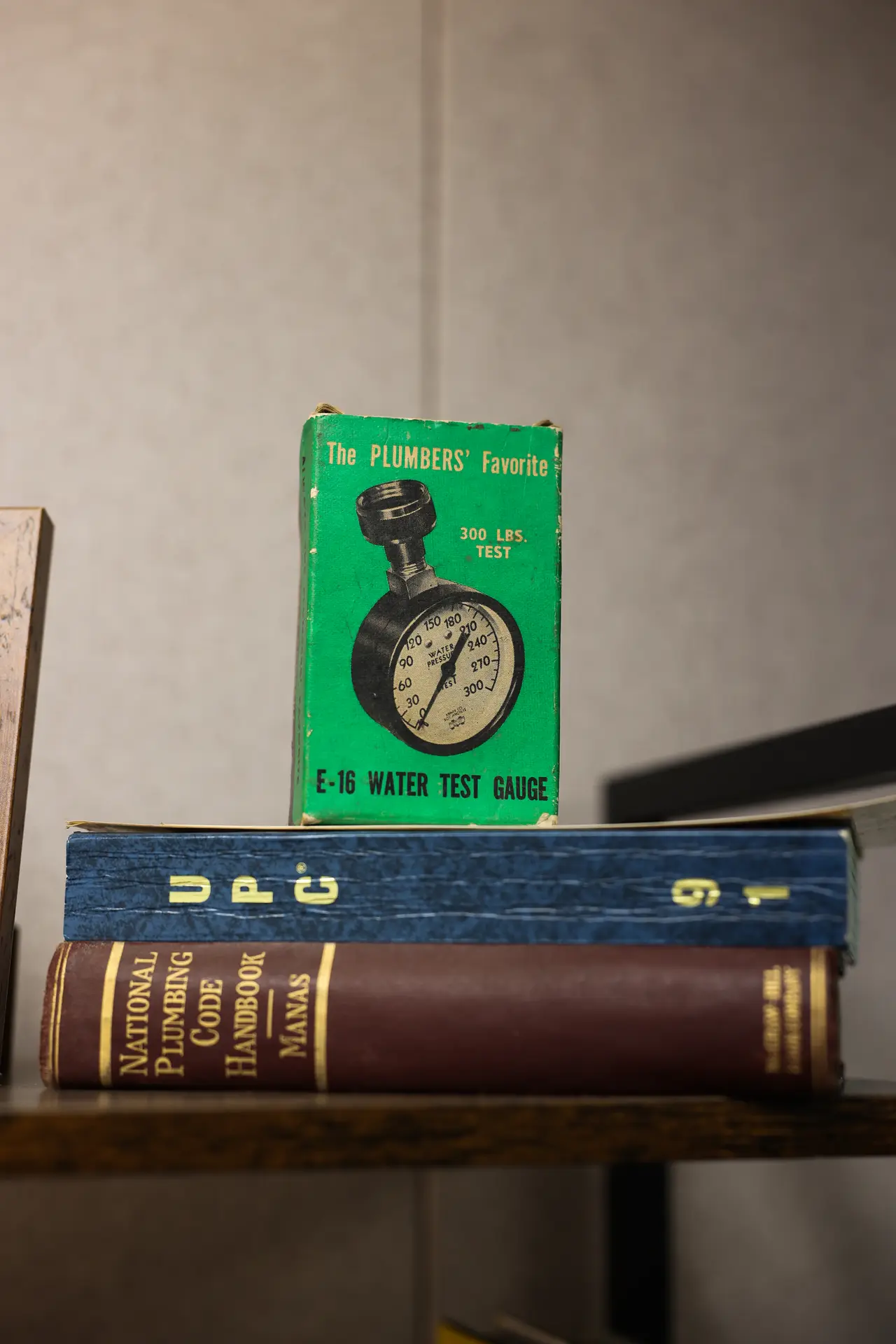
- A pressure gauge screwed onto an outdoor hose bib reading noticeably above 80 psi.
Any one of these on its own isn't necessarily proof of a failing regulator. Together, or repeated across more than one fixture, they're a strong enough pattern that it's worth having someone check the actual number rather than guessing.
The good news is that this part of the diagnosis is quick. A technician can confirm or rule out high pressure as the cause in a matter of minutes, long before any bigger repair gets discussed.
Damage that shows up before you expect it
The costlier signs are the ones that don't make noise. High pressure puts continuous stress on every seal, gasket, and connection in the house, and appliances built around a specific pressure tolerance are usually the first to show the wear.
A water heater is a common casualty, since the tank and its fittings are rated for a specific pressure ceiling. Combine that stress with the Central Coast's hard water, and a unit that should last well over a decade can start failing in half that time.
Leaks caused by pressure damage add up fast, and not just in repair costs. The U.S. Environmental Protection Agency estimates that the average household loses more than 10,000 gallons of water a year to leaks that go unnoticed, and pressure running above a safe range is one of the more common causes.
- A water heater that develops a leak or a rumbling sound years before its expected lifespan.
- A toilet that won't fully shut off, since high pressure can wear out the fill valve faster than normal use would.
- A garbage disposal that develops leaks around its seals earlier than it should.
- A water line that springs a pinhole leak with no obvious cause.
None of these problems announce themselves as a pressure issue. They just look like ordinary wear and tear, which is why so many homeowners end up replacing the symptom, a water heater here, a fill valve there, without ever addressing what's actually driving the failures.
Fixing the regulator doesn't undo damage that's already happened, but it does stop the pattern from repeating with whatever gets replaced next.
Checking your own pressure before you call anyone
A basic pressure test doesn't require a plumber. A simple gauge, sold at most hardware stores, threads onto an outdoor hose bib the same way a garden hose would, and gives a direct reading in a matter of seconds.
A reading in the 80s or higher is worth taking seriously. A reading that swings wildly between tests, high one hour and normal the next, is its own kind of red flag, since a healthy regulator should hold a steady number regardless of what the rest of the neighborhood is doing with their water at the same time.
Location matters here too. A property closer to the coast in Pismo Beach can test very differently from one a few miles inland, even within the same water district, so a single reading from a neighbor's house isn't a reliable substitute for testing your own.
A DIY test is a useful first step, but it only tells you the number. It doesn't tell you whether the regulator itself is adjustable, failing, or missing entirely, which is where a professional inspection picks up where the gauge leaves off.
Getting a regulator tested, repaired, or replaced
Once high pressure is confirmed, the fix usually isn't dramatic. Regulators are a routine part of residential plumbing, and most repairs or replacements are handled in a single visit without any need to open up walls or dig into the yard.
What that visit looks like depends on what's actually wrong, whether it's a simple adjustment, a worn part, or a valve that's clogged with sediment and needs to come out entirely.
How a technician actually diagnoses the problem
Diagnosis starts with confirming the number, usually at more than one fixture, to rule out a problem isolated to a single line rather than the whole house. From there, the process narrows down to where the pressure is actually failing to regulate.
A technician working a call in Cayucos or anywhere else in the county follows roughly the same sequence, adjusted for whatever the house's plumbing layout happens to be.
- 1Test static pressure at an outdoor hose bib and compare it to the reading inside the house.
- 2Inspect the regulator itself for visible corrosion, leaks, or a stuck adjustment screw.
- 3Check the strainer ahead of the valve, since sediment buildup there can make a working regulator behave like a failing one.
- 4Test the adjustment range to see whether the valve still responds, or whether the diaphragm has simply given out.
That sediment check matters more than people expect. In homes with harder water or older wells, a clogged strainer can mimic the symptoms of a failed regulator entirely, and clearing it sometimes solves the problem without replacing anything.
Only once every one of those steps has been ruled out does the conversation move toward actually replacing the valve rather than adjusting or cleaning it.
What goes into a proper installation
A regulator replacement is a relatively contained job. It typically means cutting into the main line at the existing valve, installing the new unit with a strainer ahead of it, and setting the pressure to a target in the 50 to 70 psi range before testing it under real household use.
Placement matters as much as the part itself. The valve has to sit in an accessible spot, typically right where it was before, so it can be adjusted or serviced again down the road without tearing into a wall or a finished space.
If the visit uncovers other pressure related wear while the technician is already in that section of pipe, it's sometimes worth addressing alongside the regulator itself, whether that means swapping in fixtures rated for lower flow or handling a smaller repair nearby while the water is already shut off.
Most installations wrap up in well under a day, and there's no reason a working regulator should need attention again for years afterward if it was sized and installed correctly the first time.
Protecting the rest of your plumbing once it's fixed
A new or repaired regulator solves the pressure problem going forward, but it doesn't undo stress that pipes, joints, and fixtures absorbed while the pressure was running high. That's worth keeping in mind rather than assuming everything downstream is automatically fine.
Homes that went years with unregulated pressure sometimes need a broader look at the plumbing behind the walls. In older homes already dealing with corroded galvanized line, replacing sections of pipe costs more than a single regulator swap, and catching the pressure problem early keeps that bigger job less likely.
That said, most homes come through a pressure correction just fine. A properly sized, correctly installed regulator is enough to prevent that broader repipe conversation from ever becoming necessary in the first place.
The simplest way to protect the investment is routine: a pressure check every few years, especially in a county where terrain and water district boundaries mean pressure can shift without much warning.
Conclusion
A pressure regulator is a small, unglamorous part of a home's plumbing, and that's exactly why it goes unnoticed until something else breaks first. Understanding what it does, and what happens when it stops doing its job, is the difference between catching a cheap fix early and paying for a water heater, a toilet, or a section of pipe that failed for a reason nobody diagnosed.
The Central Coast's mix of elevation changes, older housing stock, and water districts that don't all deliver the same pressure makes this a more common issue here than in flatter, newer markets. That's not a reason to worry about every fixture that acts up, but it is a reason to take a hissing hose bib or a water heater that failed too soon seriously enough to have the pressure checked.
If it's been a while since anyone tested the pressure at your home, or if something on this list sounds familiar, Drain Doctors Plumbing can test it, explain exactly what's going on, and handle the repair or replacement without turning it into a bigger job than it needs to be.