
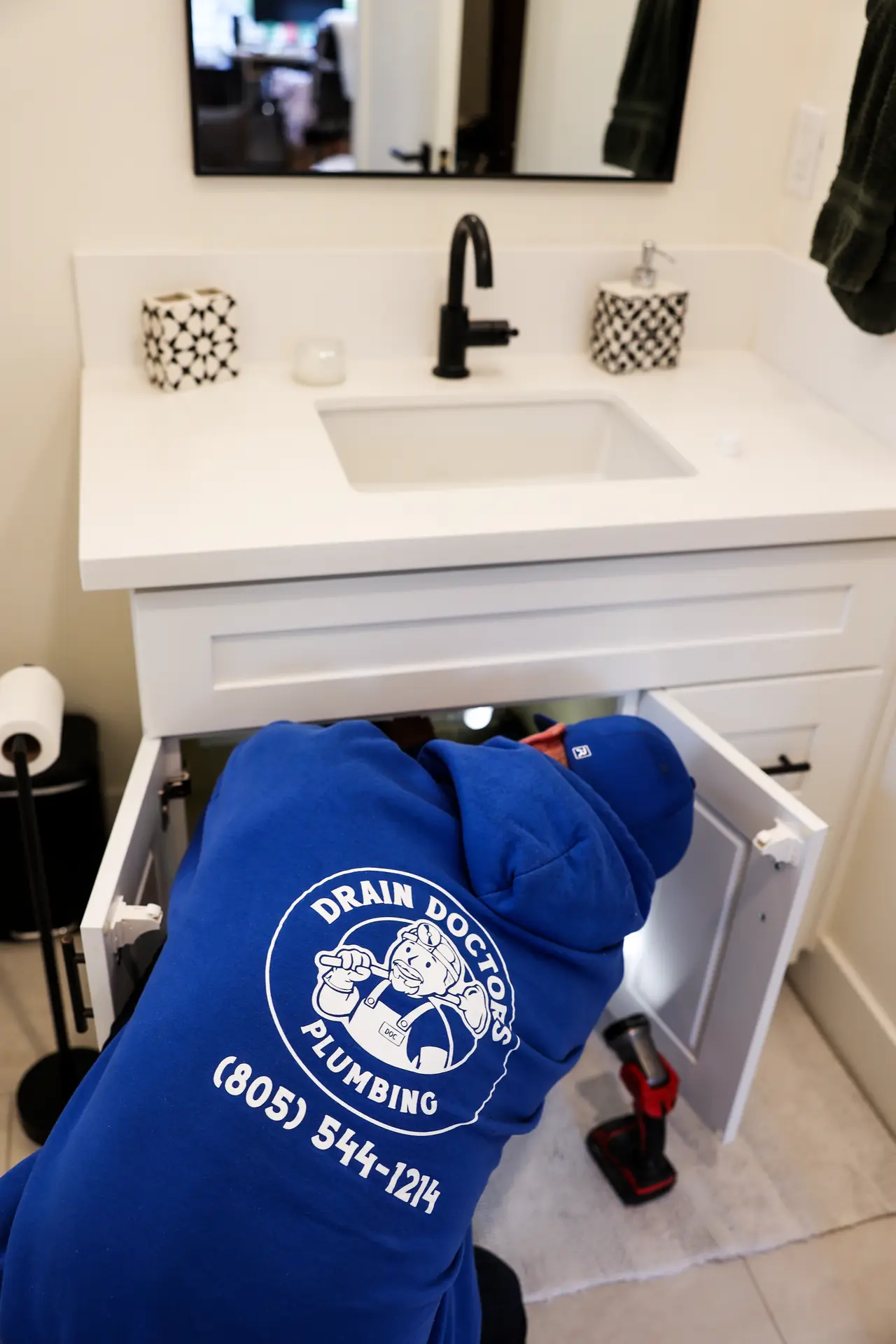
A faucet handle hard to turn fix starts with finding where the resistance comes from. The handle may be binding against the trim, mineral deposits may be restricting the cartridge, or worn parts inside the valve may no longer move smoothly. Forcing the handle can turn a manageable repair into a broken stem, damaged cartridge, or leaking faucet.
The pattern matters. A handle that is stiff only when cold can point in a different direction than one that binds through its full travel. If every fixture has changed at once, the cause may reach beyond a single faucet and into your home's water pressure or supply system.
You do not need to disassemble the faucet to collect useful clues. Where the resistance starts, whether the faucet drips, and whether the flow has changed can help separate a handle problem from a cartridge, valve, pressure, or piping problem.
In this article, you will learn about:
- Pinpointing where a stiff faucet handle is binding
- Understanding what makes faucet handles difficult to turn
- Trying safe checks without damaging the fixture
- Deciding between faucet repair and replacement
Keep reading to diagnose the resistance carefully and choose a fix that restores smooth operation without creating a leak.
Pinpointing where a stiff faucet handle is binding
Before reaching for a wrench, operate the handle slowly and pay attention to what you feel. Resistance at the very start, grinding during the turn, and a sudden hard stop are not interchangeable symptoms.
Also watch what happens at the spout and base. A stiff handle paired with dripping, wobbling, or water around the trim gives you more information than stiffness alone, and it may change the scope of the needed faucet repair.
Compare the motion through the full handle travel
A single-lever faucet should move through its designed arc without scraping the faucet body or requiring a sharp jerk. A two-handle faucet should open and close predictably without needing extra force near the shutoff point.
Run a simple comparison before taking anything apart. Use normal hand pressure, stop if the handle feels ready to snap, and observe the same details each time.
- Note whether the resistance begins immediately or partway through the turn
- Compare the hot and cold handles on a two-handle faucet
- Check whether the handle feels gritty, springy, loose, or locked
- Watch for dripping while the handle is fully closed
- Listen for banging or vibration as the water starts or stops
These observations narrow the possibilities. One stiff handle on a two-handle faucet usually keeps the investigation at that handle, stem, or cartridge, while equal resistance on both sides raises questions about age, mineral exposure, or how the fixture was installed.
Do not use the other handle as a strength benchmark if it is loose or leaking. Both sides can be worn in different ways, and the smoother one is not necessarily working correctly. A broader sink inspection and repair can account for the faucet, mounting, supply connections, and shutoffs together.
Separate handle resistance from weak water flow
A hard-to-turn handle describes mechanical resistance at the control. Low flow describes the amount of water leaving the spout. They can occur together, but one does not prove the other.
If the handle moves normally but the stream is weak at only one sink, debris in the aerator or an issue at that fixture is more likely than a whole-home supply problem. If several fixtures weakened around the same time, a main-line restriction or regulator problem deserves attention.
The U.S. Environmental Protection Agency's lavatory faucet performance overview notes that qualifying faucets are tested for a minimum flow of 0.8 gallons per minute at 20 pounds per square inch and for continued function after 500,000 operating cycles. Those benchmarks show that flow and handle durability are distinct performance questions, even though the same aging faucet can eventually struggle with both.
A sudden pressure change at multiple fixtures is especially important context. Document when it began and whether hot and cold water are equally affected; that timeline helps distinguish a local cartridge issue from a sudden pressure drop elsewhere in the system.
Look for movement at the base and water below the sink
Hold the faucet body lightly while someone else operates the handle. The body should stay stable. If the entire fixture twists, the mounting hardware may be loose, and continued use can strain the supply lines under the sink.
Dry the faucet base, countertop, cabinet floor, and supply connections with a towel. Then operate the faucet and check again. Water at the base may come from a failed seal or internal leak, while moisture farther back in the cabinet can come from a connection, drain, disposal, or another source.
Do not assume every wet cabinet begins at the faucet. An under-sink inspection may reveal a leaking garbage disposal connection, loose drain joint, or supply leak that happens to appear when the faucet is used.
Persistent dampness, cabinet swelling, or a meter that moves with all fixtures off calls for a wider investigation. The same hidden-leak warning signs can help reveal when the stiff handle is only one symptom and protecting the cabinet, wall, or flooring is the more urgent issue.
Understanding what makes faucet handles difficult to turn
Inside the faucet, the handle transfers your movement to a cartridge, ball, stem, or ceramic-disc assembly. When those parts accumulate deposits, lose lubrication, corrode, or wear unevenly, the extra friction reaches your hand first.
The exact design determines the repair. Kitchen, bathroom, tub, and shower controls can look similar from the outside while using different retainers, seals, and cartridges inside, so matching parts by appearance alone is unreliable.
Mineral deposits can bind the handle and cartridge
Water leaves small amounts of dissolved minerals behind as droplets evaporate. The white or chalky crust visible around a handle is only the external evidence; deposits can also develop where a cartridge slides, rotates, or seals inside the valve body.
San Luis Obispo County has multiple water systems and sources, so mineral conditions are not identical at every address. Still, Central Coast homeowners who notice repeated scale on fixtures may benefit from evaluating overall water treatment, especially when the same buildup returns at several sinks and showers.
Look for a pattern before deciding the buildup is only cosmetic. Mineral-related clues can appear in several places around the fixture.
- White or chalky residue collects at the handle seam
- The handle feels gritty rather than simply tight
- The aerator develops scale or needs repeated cleaning
- Similar deposits appear on nearby showerheads and fixtures
None of these observations proves that the cartridge is reusable. They show where deposits are accumulating and whether the issue is limited to one faucet or recurring throughout the home.
If only the handle is stiff while the visible surfaces remain clean, worn seals, corrosion, or trim interference may be more likely. A careful diagnosis still needs to separate those causes before parts are ordered.
Surface deposits may yield to a manufacturer-approved cleaning method, but internal scaling is different. Soaking the outside of a faucet cannot restore a cartridge that is scored, swollen, or packed with debris inside the valve.
Minerals can affect more than faucet controls. If scale also appears on showerheads, appliances, or hot-water equipment, the pattern is consistent with the same hard-water effects acting across multiple components rather than an isolated housekeeping issue.
Worn cartridges, seals, and stems create friction
Cartridges and stems are moving, sealing parts. Over thousands of uses, seals can flatten, O-rings can drag, and plastic or metal surfaces can wear. Old lubricant may wash away or collect debris, making the handle progressively harder to move.
A worn part often produces more than stiffness. You may feel uneven movement, hear a squeak, see a drip after shutoff, or notice that the handle no longer stops in its former position. Those combined symptoms make an internal plumbing repair more likely than a simple exterior cleaning.
Some cartridges can be replaced while the faucet body remains in place. Success depends on identifying the manufacturer and model, shutting the water off reliably, extracting the old part without damaging the valve, and installing the correct replacement in the correct orientation.
If the shutoff valves are seized, leaking, or inaccessible, the job changes before cartridge removal begins. Old supply connections and brittle components may need attention so the fixture can be isolated and tested without creating a second failure.
Corrosion, misalignment, and pressure can add strain
Corrosion can seize a handle screw, stem, retaining nut, or cartridge to the surrounding metal. Misaligned trim can also rub against the faucet body and imitate an internal failure. These conditions require different corrections, which is why the point of resistance matters.
High water pressure does not usually make a handle instantly hard to turn, but it can increase stress on seals, valves, and connections throughout the home. Repeated fixture wear, banging, and small leaks can signal hidden pressure damage rather than a run of unrelated bad luck.
Pressure should be measured rather than judged by how forceful one faucet feels. A gauge reading and an understanding of what the pressure regulator does can show whether the supply side is contributing to recurring fixture problems.
Older piping can add sediment, rust, or flow restrictions to the picture. When several fixtures show staining, poor flow, and repeated valve trouble, pipe repair or repiping may be part of the long-term conversation, but one stiff faucet handle alone is not proof that the house needs new pipes.
Trying safe checks without damaging the fixture
There is a useful line between observation and disassembly. You can clean accessible surfaces, test the handle gently, check for leaks, and gather identifying information without committing to a repair you cannot reverse.
Once a handle, cartridge, or valve is opened, water isolation and correct replacement parts become essential. Stop before that point if the shutoffs do not work, the fixture is corroded, or you are unsure how the assembly comes apart.
Clean accessible buildup and inspect the handle fit
Start with the faucet manufacturer's care instructions when they are available. Abrasives and harsh chemicals can damage plated, painted, or specialty finishes even when they remove visible scale.
Use a soft cloth to clean around the handle seam and base. If the design has a removable decorative cap, do not pry it with a metal tool unless the instructions specifically call for that method.
- 1Dry the fixture and verify where the handle is rubbing or binding.
- 2Clean only the exposed surfaces with a finish-safe product.
- 3Rinse and dry the area so residue does not remain in the seam.
- 4Move the handle gently through its normal range without forcing it.
- 5Recheck the base, spout, and cabinet for water.
Exterior cleaning may solve resistance caused by residue between moving trim pieces. It will not repair a cracked handle, seized stem, damaged cartridge, or corroded retaining hardware.
If the faucet remains stiff, record the brand name and take clear photos of the fixture and handle. That information can shorten part identification for a bathroom plumbing visit or kitchen sink repair.
Test the shutoffs before planning cartridge work
Most sink faucets have separate hot and cold shutoff valves below the basin. Their presence does not guarantee they will close fully, especially if they have not moved in years.
Turn a shutoff only with ordinary hand pressure and watch the stem and connection for leakage. If it is stuck, heavily corroded, or begins to drip, stop. Forcing a failed shutoff can create a pressurized leak inside the cabinet.
After a reliable shutoff is closed, open the faucet to confirm the flow stops and to relieve remaining pressure. If water continues, the valve may not be isolating the fixture, and cartridge removal should wait until the water can be controlled safely.
Supply-side concerns may extend beyond the faucet when shutoffs and connections are deteriorated at several fixtures. Repeated corrosion or leaks can justify a closer look at the home's water lines rather than treating every failed valve as unrelated.
Know why forcing or lubricating the handle can backfire
Extra leverage can snap a handle, shear a stem, crack a cartridge, or loosen the faucet at the deck. The new problem may be a handle that spins without controlling water or a valve that will not shut off.
Household oils and spray lubricants are also a poor shortcut. They may not be approved for potable-water fixtures, may damage rubber components, and can trap more debris. Faucet manufacturers specify compatible products and replacement procedures for a reason.
If a handle requires unusually high effort, usability matters as much as mechanical condition. The U.S. Access Board's guidance for sink faucets uses a 5-pound maximum operating force for accessible controls and says manual controls should work with one hand without tight grasping, pinching, or wrist twisting.
That standard does not diagnose a residential faucet, but it provides a practical perspective: a control should not demand a painful grip. A stiff shower or tub control deserves the same caution, and shower valve repair may require access and parts that differ from a sink faucet.
Deciding between faucet repair and replacement
Repair is often sensible when the faucet body is sound, the finish is in good condition, and a correct cartridge or stem remains available. Replacement becomes more attractive when corrosion, looseness, leaks, unavailable parts, and poor usability overlap.
The decision should account for the connections below the fixture too. A new faucet installed on failing shutoffs or damaged supply lines does not resolve the underlying risk, while replacing a good faucet for a serviceable cartridge wastes usable equipment.
Repair makes sense when the failure is isolated
A stiff cartridge, worn O-ring, loose handle connection, or small amount of accessible scale may be repairable. The work should restore smooth movement, a reliable shutoff, and a dry faucet base.
Age alone does not decide the outcome. A well-made older faucet with available parts may be worth keeping, while a newer fixture with a cracked body or proprietary parts may not be economical to rebuild.
Ask for the diagnosis in specific terms. “The faucet is old” is less useful than knowing whether the cartridge is seized, the valve body is scored, the mounting has loosened, or the shutoffs cannot isolate the sink.
Verification matters after any repair. Cycle the handle, test hot and cold flow, close it normally, and inspect above and below the sink. A repair is not complete if the handle moves better but the base or supply connection now leaks.
Replacement can improve reliability and daily usability
Replacement is reasonable when the body is corroded, the mounting no longer holds, repairs keep recurring, or compatible parts are unavailable. It also gives you an opportunity to choose a control that suits the people who use the sink.
The CDC's national arthritis analysis found that 53.2 million U.S. adults, or 21.2 percent, reported diagnosed arthritis during 2019 through 2021. For a household member with hand pain, reduced grip, or limited dexterity, a lever handle or touch-activated control can make the sink noticeably easier to use.
Think beyond style when comparing fixtures. Check the hole configuration, spout reach, clearance to the backsplash, supply connections, finish care, replacement-part availability, and whether the control can be operated comfortably with one hand.
A remodel or fixture upgrade may also be the right time to consider low-flow fixtures. Efficiency matters, but smooth handle operation, adequate reach, and compatibility with the sink still determine whether the finished installation works well every day.
A systemwide pattern deserves broader diagnosis
One hard-to-turn handle is usually a fixture-level problem. Similar symptoms across several faucets, combined with rust-colored water, weak flow, banging, or recurring leaks, justify looking past the individual cartridges.
Use a whole-home pattern check before deciding on a larger repair. The goal is to identify related evidence, not to assume the worst from a single symptom.
- Compare hot and cold flow at several sinks and showers
- Note whether pressure changes when another fixture runs
- Look for repeated scale, corrosion, or staining at different fixtures
- Check whether valves and supply lines are the same age throughout the home
- Record banging, visible leaks, and unexplained meter movement
These observations help determine whether the next step is one cartridge, a regulator test, water-quality evaluation, or a piping inspection. You can also test home water pressure with the right gauge if the plumbing configuration allows it, but one reading should be interpreted in context.
Older homes with repeated restrictions, corrosion, and repairs may eventually show broader signs that repiping is needed. That conclusion should follow an inspection of the material and system condition, not a guess based on faucet stiffness.
If multiple fixtures and supply components are deteriorating, the causes can include age, material, water conditions, and pressure. Understanding why older water lines fail helps put the faucet symptom in the larger system without treating every stiff handle as a repipe emergency.
Conclusion
A hard-to-turn faucet handle is usually a warning about friction, buildup, wear, corrosion, or misalignment inside or around the control. The safest diagnosis starts with the resistance pattern, flow, leaks, mounting stability, and condition of the shutoffs.
Gentle exterior cleaning may resolve residue around the trim, but force and improvised lubricants can damage the fixture. When the cartridge is seized, the valve body is corroded, or several plumbing symptoms appear together, a complete diagnosis protects the faucet and the surrounding connections.
Drain Doctors Plumbing checks the handle, cartridge, valve body, mounting, supply connections, and pressure clues before recommending repair or replacement. Contact Drain Doctors Plumbing to schedule service for a stiff, stuck, dripping, or difficult-to-use faucet.
Tell us what's going on and our licensed team will point you in the right direction. Call (805) 467-1214 or request service online.