
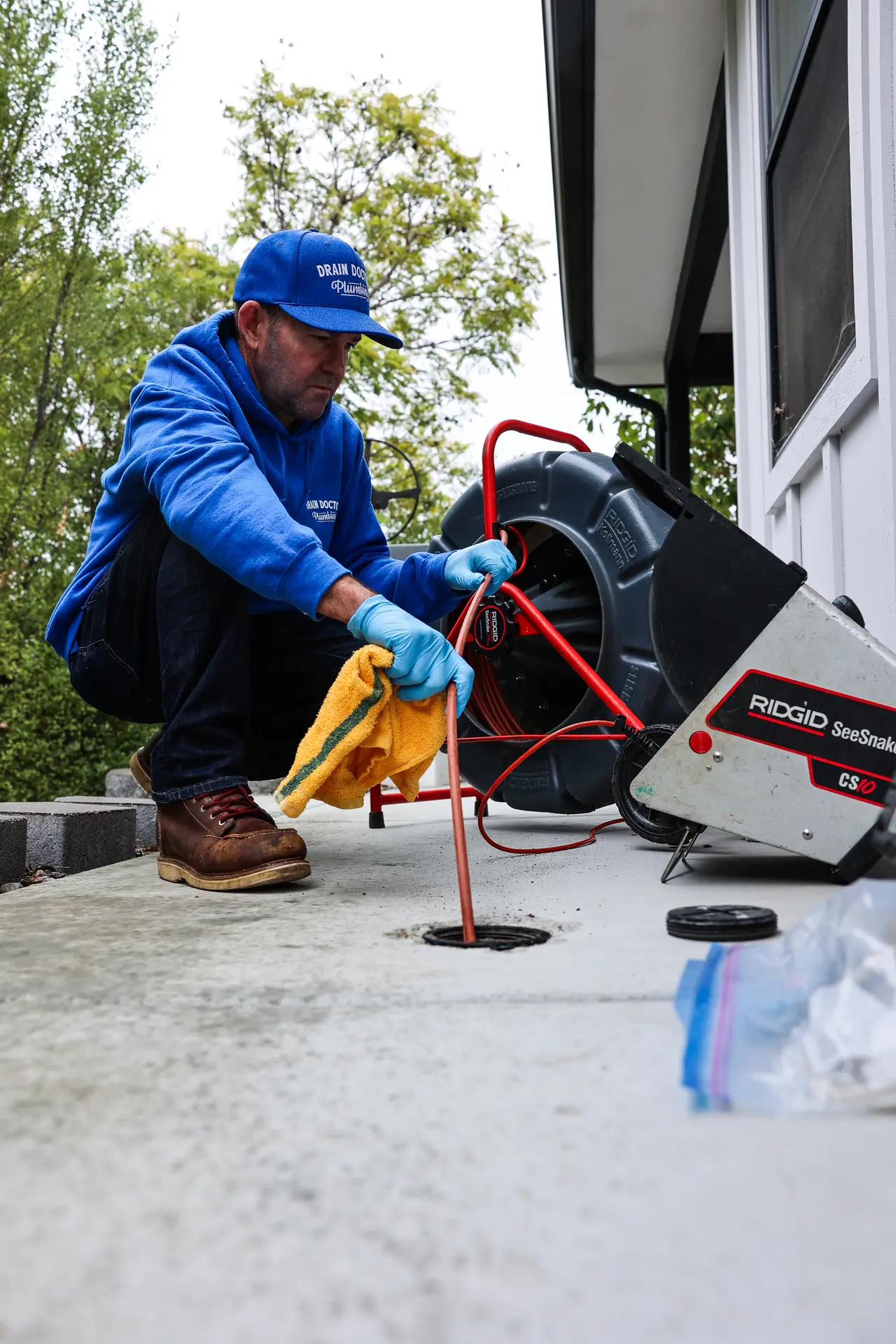
Walk through almost any older neighborhood in San Luis Obispo County and you will notice the same thing that makes the streets pretty is often the same thing quietly wrecking the sewer lines underneath them. Tree roots and sewer lines have been fighting each other for decades in these areas, and the roots usually win first.
It is not a coincidence that the same mature trees giving a street its character are frequently the reason a homeowner ends up with a backed-up drain on a Sunday night. Older neighborhoods pair aging clay or cast iron pipe with decades of unchecked root growth, which is close to the worst possible combination a sewer line can face.
This guide walks through why that combination is so common locally, what actually happens underground once a root finds a way in, the warning signs that show up long before a full backup, and how professionals actually diagnose and fix the problem without guessing.
If your home was built before the 1980s and sits under or near a mature tree, older San Luis Obispo neighborhoods are exactly the kind of setting where this problem tends to show up first.
In this article, you will learn about:
- Why old San Luis Obispo neighborhoods are exactly where roots win
- What's actually happening underground when roots move in
- The warning signs before a backup reaches your house
- How professionals actually find and fix root intrusion
Keep reading to find out what is happening under your yard right now, and how to catch it before it turns into a flooded bathroom.
Why old San Luis Obispo neighborhoods are exactly where roots win
Root intrusion is not random bad luck. It follows a predictable pattern tied to pipe material, pipe age, and how close a mature tree happens to sit to the line. Older neighborhoods check every one of those boxes at once.
Understanding why this keeps happening in the same kinds of neighborhoods makes it much easier to know whether your own property is at elevated risk.
Root intrusion is not a minor contributor to sewer failures either. The U.S. Environmental Protection Agency has documented cases where roots accounted for more than 50 percent of sewer spills in a California water district's collection system, ahead of grease, debris, or any other single cause.
The buried section connecting a house to the main line, commonly called the sewer lateral, is exactly the piece of pipe most exposed to this kind of damage. California's point-of-sale sewer lateral inspection law can require this exact section of pipe to be inspected before a home sale closes, which catches a surprising number of long-hidden root problems.
Clay and cast iron pipe were never root-proof
Homes built before the 1970s and 1980s were commonly plumbed with clay or cast iron sewer pipe, both of which rely on joints between shorter pipe sections rather than one continuous run. Those joints are the weak point. Over decades, ground movement, soil settling, and simple age open tiny gaps at each joint, and a root only needs a hairline crack to find the moisture and nutrients on the other side.
Not every pipe material carries the same level of risk once a tree is nearby:
- Clay pipe: highly vulnerable, joints separate easily over time
- Cast iron pipe: vulnerable at joints and at any point where corrosion has thinned the pipe wall
- Orangeburg pipe: an older tar-paper composite pipe that is especially prone to failure and root entry
- Modern PVC pipe: far more resistant, since sections are solvent-welded rather than simply joined
A home with the original clay or cast iron sewer line still in the ground is working with sixty, seventy, or even ninety-year-old infrastructure. That age alone increases the odds of a compromised joint somewhere along the run, long before roots even enter the picture.
This mix of aging infrastructure is common in older neighborhoods throughout Paso Robles and in similarly historic pockets scattered across the county.
Decades of mature tree growth over the same buried line
A tree planted the same year a house was built has had just as many decades to grow a root system as the sewer line below it has had to age and develop weak points. By the time that tree is fully mature, its root system has often spread well beyond the visible canopy, sometimes extending two to three times the width of the tree itself.
Certain species are especially aggressive about seeking out buried moisture:
- Ficus trees, common as street trees in many older subdivisions
- Coast live oak, native to the region and known for extensive root systems
- Sycamore and other fast-growing shade trees planted along older streets
- Willows, when present near a property line or drainage easement
None of this means removing every mature tree near a sewer line. It means understanding that a large, established tree sitting near an aging clay or cast iron line is close to a guaranteed eventual intrusion rather than a remote possibility.
Streets lined with mature Ficus or oak in the older sections of Morro Bay show this pattern especially clearly, with trees planted decades ago now sitting directly above original clay laterals.
How pipe age compounds the risk
Pipe material and tree proximity matter individually, but they compound each other. A young PVC line near a mature tree faces relatively low risk. An aging clay line near the same tree faces dramatically higher risk, since the joints have already had decades to develop the small openings roots exploit.
Aging sewer laterals are often just one piece of a bigger infrastructure picture inside an older home. Original galvanized supply piping frequently shows up in the same houses, and recognizing when a home needs a repipe is a closely related conversation many owners of these older properties eventually have alongside sewer line concerns.
This compounding effect is exactly why root intrusion clusters so heavily in specific older pockets of the county rather than showing up evenly everywhere. A neighborhood built in the 1960s with mature street trees and original clay laterals is simply a different risk category than a subdivision built in the 2000s with PVC plumbing throughout.
What's actually happening underground when roots move in
Once a root finds an opening, what happens next follows a fairly predictable timeline. Understanding that progression helps explain why a minor slow drain today can become a full sewer backup within a surprisingly short window.
The process is slower than most homeowners assume at first, but it accelerates quickly once a root system establishes itself inside a pipe.
How a root finds its way into a pipe joint
Tree roots grow toward moisture and nutrients, and a leaking sewer joint is essentially a constant, reliable source of both. A tiny root hair, often no thicker than a strand of hair, is enough to work its way through a hairline gap. Once inside, that root has access to warmth, moisture, and organic material, which is close to ideal growing conditions.
The root does not stop at the size of the original opening. It continues to grow inside the pipe, gradually expanding the gap it entered through and creating more room for additional roots to follow the same path.
Homes in Atascadero with original clay laterals show this exact progression regularly, often years before any visible symptom shows up inside the house.
From a thin root hair to a full blockage
What starts as a single fine root inside a pipe eventually becomes a dense mass, sometimes resembling a mop head made of roots, as the tree continues sending growth toward that same reliable water source. That mass catches toilet paper, grease, and other debris flowing through the line, which is usually what turns a partial obstruction into a full blockage.
This progression rarely happens overnight. It typically plays out over several stages:
- 1A fine root enters through a joint gap and begins growing inside the pipe
- 2The root mass thickens as the tree continues directing growth toward the moisture source
- 3Debris and waste begin catching on the root mass, narrowing the usable pipe diameter
- 4Flow slows noticeably, showing up first as slower drains throughout the home
- 5A full blockage develops, often during a period of heavier than normal water use
Regular professional drain cleaning on a known problem line can slow this progression considerably, even when the root intrusion itself has not yet been addressed at the source.
Why a slow drain today is a bigger problem tomorrow
A slow drain is easy to dismiss as a minor annoyance, especially when it only affects one fixture or seems to come and go. With root intrusion specifically, that slow drain is rarely staying the same. The root mass inside the pipe continues growing whether or not anyone notices the early symptoms.
Why drains keep clogging in Central Coast homes often traces back to exactly this kind of underground obstruction rather than anything happening inside the house itself, which is part of why a clog that keeps coming back despite repeated attempts to clear it from indoors deserves a closer look at the main line.
The warning signs before a backup reaches your house
A sewer line rarely fails without giving some notice first. The signs are often subtle enough to miss, especially when they show up gradually, but catching them early is the difference between a planned repair and an emergency cleanup.
Most homeowners who end up with a full backup can look back and identify at least one or two signs that had been building for weeks or months beforehand.
Gurgling drains and slow-draining fixtures
A gurgling sound coming from a toilet, tub, or floor drain, particularly one that happens when a different fixture is in use, points to trapped air in the line, which is a classic sign of a partial obstruction. Slow drainage that affects multiple fixtures at once, rather than just one, usually points toward the main line rather than an isolated local clog.
A handful of patterns tend to show up together when a root mass is developing in the main line:
- Multiple drains slowing down around the same time, rather than just one
- Gurgling noises when a toilet is flushed while another fixture runs
- Water backing up into a shower or tub when the washing machine drains
- Toilets that require multiple flushes to clear normally
Any one of these on its own might not mean much. Several of them showing up together, especially in a home with an older clay or cast iron line, is a strong enough pattern to warrant a closer look before it becomes an actual backup. A kitchen sink that keeps backing up despite repeated clearing is a common early complaint that traces back to exactly this kind of main line issue more often than homeowners expect.
Sewage odor that won't go away
A persistent sewage smell, either inside the home near a drain or outside near where the sewer line runs, often means a small amount of waste is escaping through a compromised joint before it ever reaches a full blockage. This is different from a brief, occasional odor, which can have many harmless causes.
If the smell keeps returning despite normal use and cleaning, it is worth treating as a sign of a developing problem underground rather than something a drain cleaner will permanently solve. Warning signs of a failing sewer line that homeowners commonly overlook tend to include exactly this kind of low-level, recurring odor.
Homeowners in Pismo Beach and other coastal communities sometimes mistake this smell for something related to nearby storm drains, which can delay catching an actual sewer line problem for months.
A suspiciously green patch of lawn
A section of lawn that stays noticeably greener and grows faster than the surrounding grass, tracing roughly along the path of the sewer line, is one of the more overlooked signs of a slow leak. Escaping wastewater acts as an unintentional fertilizer, and grass responds accordingly.
This sign is easy to miss because it looks like a positive thing at first glance rather than a warning sign. A homeowner in Arroyo Grande who notices one particularly lush strip of lawn running from the house toward the street, especially if it lines up with where the sewer lateral is likely buried, has a genuinely useful clue worth following up on.
How professionals actually find and fix root intrusion
Guessing at what is happening underground rarely ends well, since digging in the wrong spot wastes time and money without solving the actual problem. Professional diagnosis starts with seeing the issue directly rather than assuming.
The good news is that modern tools make it possible to know exactly what is happening in a sewer line before any digging begins.
Camera inspection before anyone touches a shovel
A sewer camera inspection sends a waterproof camera directly through the line, giving a real-time, recorded view of exactly where roots have entered, how severe the intrusion is, and what condition the surrounding pipe is in. This removes the guesswork entirely from what would otherwise be an educated estimate.
A camera inspection typically reveals several useful pieces of information at once:
- The exact location of root intrusion, measured from the cleanout or access point
- Whether the intrusion is at a single joint or spread across multiple points
- The overall condition of the surrounding pipe material
- Whether the blockage is primarily roots, or roots combined with grease, scale, or debris
That information determines everything that happens next, from which clearing method makes sense to whether repair is realistic or replacement is the more honest recommendation. Homeowners in Santa Maria and elsewhere across the county consistently find that footage settles disagreements over the actual condition of a line far faster than any amount of guessing.
Hydro jetting versus mechanical snaking for roots
Mechanical snaking uses a rotating cutting head to physically cut through a root mass, which works well for opening a line quickly but does not necessarily clear the pipe walls of everything the roots left behind. What hydro jetting actually is helps explain why it tends to outperform snaking for root removal specifically, since it uses high-pressure water rather than a cutting head.
Comparing hydro jetting and snaking as clog-clearing methods matters specifically for root intrusion, since snaking alone tends to leave enough root material behind that regrowth happens faster than it would otherwise. A thorough hydro jetting treatment tends to clear that residual material more completely. Neither method changes the underlying joint gap that let the root in to begin with, which is why root intrusion tends to return eventually no matter which clearing method is used, unless the joint itself is addressed.
When repair holds and when replacement is the honest answer
A single, isolated joint with minor root intrusion can often be repaired without addressing the entire line, especially when a camera inspection confirms the rest of the pipe is in reasonably good condition. Sewer line repair or replacement decisions come down to a fairly consistent set of factors once the camera footage is in hand.
A few questions tend to guide whether repair or full replacement makes more sense:
- 1Is the root intrusion isolated to one joint, or spread across multiple points along the line
- 2What condition is the surrounding pipe material in beyond the immediate intrusion point
- 3How old is the line, and what material is it made of
- 4How often has this same line needed clearing in the past few years
Deciding between sewer line repair and replacement in Nipomo and Arroyo Grande walks through this same decision process in more depth, and the same logic applies to any older neighborhood across the county dealing with a line that keeps clogging in the same spot. Homes in Nipomo with original clay laterals see this exact scenario play out often enough that it has become a fairly routine part of owning an older property there.
Conclusion
Tree roots and sewer lines have been in conflict under older San Luis Obispo neighborhoods for as long as those neighborhoods have had both mature trees and aging clay or cast iron pipe in the ground. That combination does not resolve itself, and it rarely gets better without some form of intervention.
Catching the early signs, a slow drain, a recurring odor, an oddly green patch of lawn, gives you the chance to address the problem with a planned repair rather than an emergency backup on a weekend. A camera inspection removes the guesswork entirely and tells you exactly what is happening before any decision gets made.
If your home sits in an older part of the county and you are noticing any of these warning signs, the team at Drain Doctors Plumbing can send a camera down the line and give you a clear, honest answer about what is actually going on underground.